Can You Take a Cat on a Plane? Cabin Rules, Fees, and Papers
Key takeaways
- Most major U.S. airlines will take a small cat in the cabin if the closed carrier fits under the seat and a limited pet slot is reserved in advance.
- The FAA (updated December 2025) lets each airline set cabin-pet policy; when pets are allowed, the carrier is carry-on baggage that must stay stowed while the aircraft is moving.
- As of August 2026, published one-way U.S. cabin fees include $150 on Delta (tickets issued on or after 8 April 2025) and American, and $125 per carrier on Southwest’s mainland network.
- TSA requires the cat out of the carrier at the checkpoint; never put a live animal through the X-ray.
- CDC (22 August 2025) does not require rabies proof for cats entering the United States, but Hawaii and Guam impose local quarantine, and foreign destinations often require USDA-endorsed certificates.
- An EU pet passport is an official government travel document for cats; Animal Passport’s muzzle-biometric livestock product is not a substitute for airline or border papers.
- IATA and AVMA discourage routine sedation of cats for air travel because of altitude-related breathing and heart risks.
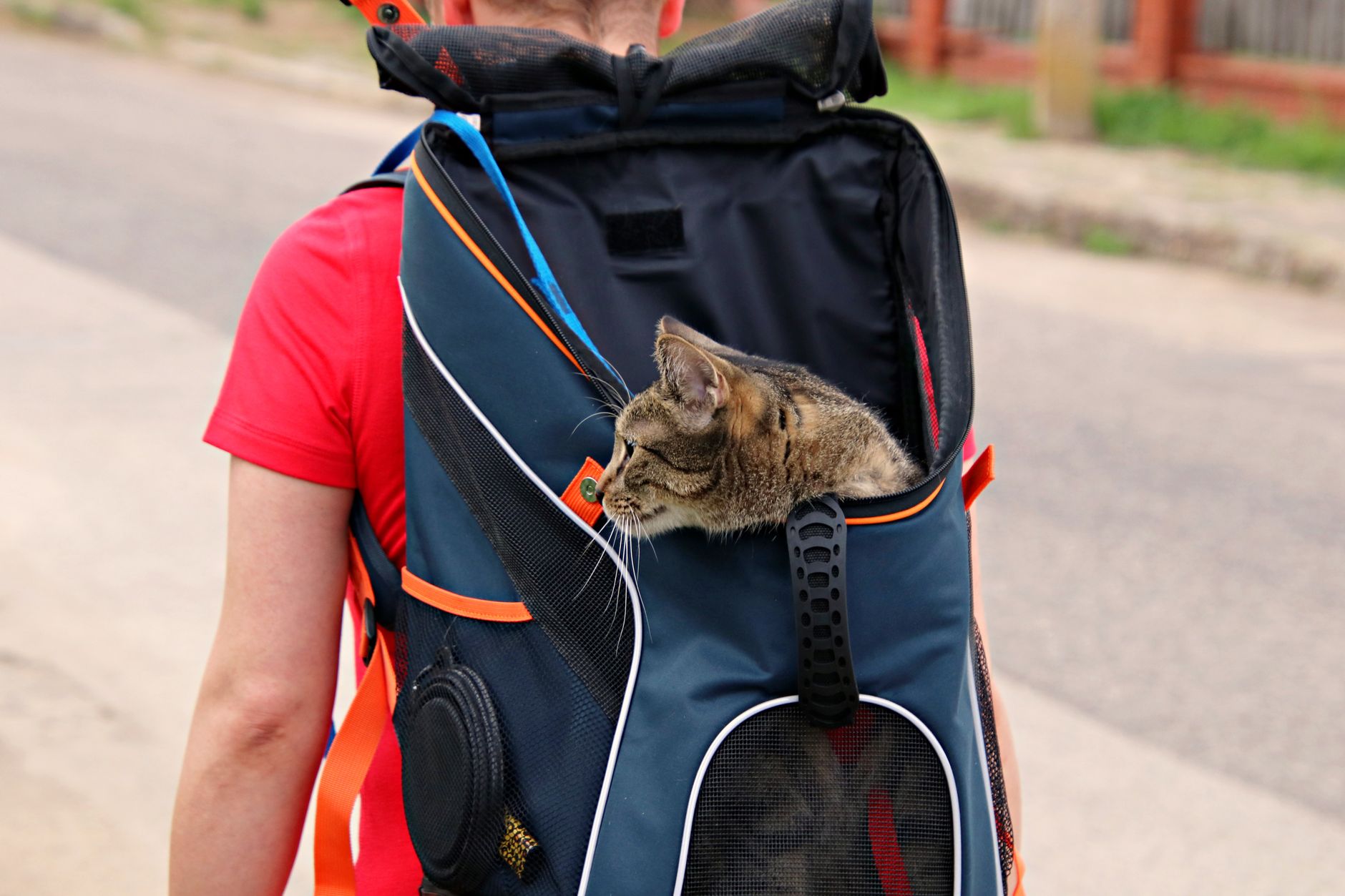
Yes, you can take a cat on a plane. In-cabin cat travel means a small cat rides with you in a closed, ventilated carrier that fits under the seat in front of you. As of August 2026, most major U.S. airlines sell limited cabin-pet slots on domestic flights for a one-way fee. The Federal Aviation Administration (FAA) lets each airline decide whether cabin pets are allowed; if they are, the container counts as carry-on baggage.
This Animal Passport briefing, last updated 19 August 2026, summarizes FAA, TSA, USDA APHIS, CDC, IATA, airline, EU, and UK rules. It is not veterinary diagnosis or legal advice. Recheck the operating carrier before you buy tickets.
How in-cabin cat travel works
The FAA does not require airlines to accept pets in the passenger cabin. Its Flying with Pets page, last updated 4 December 2025, states that each airline decides. If cabin pets are allowed, the container is carry-on baggage under 14 CFR 121.589.
The container must fit underneath the seat without blocking the aisle, be stowed before the last passenger door closes, and remain stowed while the airplane is moving on the surface and for takeoff and landing, according to the Federal Aviation Administration (FAA, 2025).
Airlines add caps on pets per flight and usually require the cat to stay in the container for the whole flight. Service animals are not pets. U.S. Department of Transportation rules in 14 CFR part 382 require U.S. airlines to accept trained service animals that assist a person with a disability.
IATA's Traveler's Pet Corner states that only small dogs and cats can go in the cabin. IATA Operational Guidelines for In-Cabin Pet Transport, Edition 1 (15 July 2026), say cats may travel in the cabin subject to airline policy if they meet Container Requirement 1 of the IATA Live Animals Regulations (LAR), 52nd edition (2026): stand, sit erect, lie naturally, and turn around. Cabin containers need not be rigid.
Cabin versus cargo in 2026
If the cat cannot fit under a seat, cabin travel is usually closed. Delta Air Lines and American Airlines (2026) largely limit checked pets to qualifying U.S. military or State Department travelers. Southwest Airlines and JetBlue Airways (2026) accept small cabin cats and do not carry pets as cargo.
How to take a cat on a plane
- Confirm the route. American Airlines (2026) does not accept carry-on pets on trans-Atlantic or trans-Pacific trips, to or from Hawaii, to Jamaica, or to or from Argentina, Brazil, Chile, Colombia, or Uruguay. Delta Air Lines (2026) does not permit in-cabin pets to or from Australia, Barbados, Hawaii, Hong Kong, Iceland, Jamaica, New Zealand, South Africa, the United Kingdom, or the United Arab Emirates, and it does not accept pets originating in Brazil, Colombia, or the Dominican Republic.
- Reserve the pet slot with your ticket. IATA's 15 July 2026 guidelines recommend booking at least 48 to 72 hours ahead. Southwest's Contract of Carriage may limit carriers to six per flight. JetBlue's Contract of Carriage dated 29 July 2026 also caps in-cabin pets at six per flight.
- Fit the carrier to the aircraft. Delta (2026) and American (2026) recommend a soft-sided kennel of about 18 by 11 by 11 inches. JetBlue (2026) sets a maximum of 17 by 12.5 by 8.5 inches. Southwest (2026) requires a leak-proof, ventilated carrier that fits under the seat and does not publish a single inch measurement on its public pet-policy page.
- Check age and how many cats. Delta, American, and Southwest require cats to be at least 8 weeks old for domestic U.S. travel. Southwest (2026) allows one carrier per passenger and up to two small cats of the same species in that carrier. JetBlue's help page (2026) allows two pets in two carriers if a second seat and fee are paid; JetBlue's 29 July 2026 contract says a passenger may not transport more than one pet per flight. Those texts disagree, so ask JetBlue which rule applies to your ticket.
- Collect destination health papers, then ask what the airline wants. USDA APHIS states that almost all countries require a USDA-accredited veterinarian to issue an international health certificate within a stated window, then APHIS endorsement (USDA, "Navigating Pet Travel? Let APHIS Help"). Airlines may add a fitness-to-fly form that APHIS does not stamp.
- Pay the pet fee at booking or the ticket counter, screen at TSA with the cat out of the box, then keep the carrier closed from the gate through landing. Southwest (2026) requires the pet, including head and tail, to remain inside in the gate area, during boarding, and throughout the flight.
What it costs: 2026 in-cabin cat fees
Fees below are one-way amounts published on airline pages opened in August 2026. They change by ticket date and route.
| Airline | In-cabin cats? | Published one-way fee | Carrier note | Route limits |
|---|---|---|---|---|
| Delta Air Lines | Yes, on eligible flights | $150 USD/CAD for U.S./Canada/Puerto Rico/U.S. Virgin Islands tickets issued on or after 8 April 2025 ($95 if issued earlier); $200 USD/CAD/EUR international | Soft-sided about 18 x 11 x 11 inches | No cabin pets to several destinations including Hawaii and the United Kingdom; not permitted in Delta One, Business, or Premium |
| American Airlines | Yes, on qualifying routes up to 12 hours | $150 per kennel within and between the United States, Canada, Mexico, Central America, and the Caribbean | Soft-sided 18 x 11 x 11 inches recommended | No carry-on pets to or from Hawaii, on trans-Atlantic or trans-Pacific trips, to Jamaica, or to several South American countries |
| Southwest Airlines | Yes, small vaccinated domestic cats on domestic flights | $125 per carrier on the U.S. mainland; $35 between Hawaiian Islands | Must fit under the seat; leak-proof and ventilated | No pets on mainland–Hawaii or international itineraries; no cargo pets |
| JetBlue Airways | Yes, small cats on domestic flights | A fee applies at reservation; the help page opened in August 2026 did not list a dollar amount | Maximum 17 x 12.5 x 8.5 inches | No pets in Mint; no animals as checked baggage; help page and contract disagree on one versus two pets |
Delta (2026) collects the cabin fee at check-in. Southwest (2026) collects it at the ticket counter and says the fare is refundable if the reservation is canceled. American (2026) says pet fees are nonrefundable; a stopover or connection of 4 hours or more triggers a fee on each segment.
TSA screening with a cat
TSA's FAQ Can I take my pet through the security checkpoint? tells you to remove the pet, X-ray the empty case, keep control of the animal, and remove the leash when carrying it through the metal detector. Never put a live cat in the X-ray tunnel. If the cat may bolt, ask for a private screening room.
USDA APHIS export papers and CDC import rules
Cabin permission is not entry permission. USDA APHIS handles U.S. export health certificates. CDC inspects animals entering the United States. USDA's pet-travel explainer states that almost all countries require a USDA-accredited veterinarian to complete, sign, and date an international health certificate within a set number of days before departure, and that APHIS typically then endorses (stamps) that certificate. IATA's Traveler's Pet Corner adds that most airlines require a veterinarian certificate that the animal is healthy and fit to fly.
CDC's Bringing an Animal into the U.S. page, dated 22 August 2025, requires cats to appear healthy on arrival. Cats may be denied entry if they show evidence of a zoonotic disease; an ill cat may need a licensed veterinarian exam at the owner's expense. CDC does not require proof of rabies vaccination for federal cat importation, though it recommends vaccination and notes that states may add rules. CDC also does not require a general health certificate for U.S. entry, while some states and many airlines do. All cats arriving in Hawaii and Guam, even from the U.S. mainland, face local quarantine rules (CDC, 22 August 2025).
Hawaii cabin bans and state quarantine
Delta (2026) and American (2026) do not accept carry-on pets to or from Hawaii. Southwest (2026) bans pets on flights to or from Hawaii but accepts them between Hawaiian Islands at $35 per carrier. The Hawaii Department of Agriculture and Biosecurity Animal Quarantine Branch still requires every dog and cat to meet rabies import rules under Hawaii Administrative Rules Chapter 4-29. Qualifying animals may use the 5 Day Or Less program, including direct airport release in Honolulu after inspection; others are quarantined for up to 120 days. Direct Airport Release in Honolulu is listed at $185 when documents arrive 10 or more days before arrival, or $244 if paperwork is late (Hawaii Animal Quarantine Information Page, accessed August 2026). A successful FAVN rabies antibody test and the most recent rabies vaccination each have a 30-day minimum wait before arrival.
EU pet passports are not Animal Passport
Official cat travel documents for the European Union and Great Britain are government schemes. They are not the biometric livestock product at animalpassport.co.
Your Europe, last checked 15 June 2026, states that a cat moving between EU countries generally needs an ISO-compatible microchip (or a readable tattoo applied before 3 July 2011), a valid rabies vaccination, and a European pet passport issued by an authorised veterinarian to an owner resident in the EU. The cat must usually be at least 12 weeks old at the primary rabies vaccination, then wait at least 21 days. Commission Delegated Regulation (EU) 2026/131 now sets those non-commercial rules for dogs, cats, and ferrets. The European Commission limits non-commercial movements to five pets in a single vehicle and requires the cat to travel with its owner or an authorised person if the owner travels within five days.
From a non-EU country the usual paper is an EU animal health certificate, valid for 10 days from issue until checks at a designated travellers' point of entry, then up to 6 months (or until the rabies vaccine expires) for further EU movement (European Commission, 2026). Many origins also require a rabies antibody test of at least 0.5 IU/ml. Airline cabin bans can still stop the trip: Delta (2026) does not accept in-cabin pets to or from the United Kingdom, and American (2026) does not accept carry-on pets on trans-Atlantic flights. GOV.UK requires an approved route into Great Britain, a microchip before rabies vaccination, a wait of at least 21 full days after the first vaccination (or the last of the first course), and a pet travel document that depends on the country of departure. Missed rules can mean up to 4 months of quarantine or refusal after a sea crossing.
Animal Passport is a digital livestock identity product. It uses muzzle biometrics (a nose print unique like a fingerprint), captured on a phone. The record binds owner, breed, estimated age, body condition, and vaccination history. Age is estimated from a dental photograph with a confidence score; body condition is scored 1 to 5 from a side-profile photo. The same identity method was used in livestock flood rescue in Pakistan in August 2025 after paper tags washed away. It is not an EU pet passport, USDA certificate, CDC permit, or airline boarding document. A microchip plus official veterinary papers remain what borders and airlines check. Related identity explainers live on Animal Passport blogs.
Sedation and onboard behavior
IATA's Traveler's Pet Corner discourages sedatives for cabin or cargo animals because of adverse effects in transit, a view IATA says is endorsed by the American Veterinary Medical Association (AVMA). American Airlines (2026) will not accept sedated pets, citing higher respiratory and cardiovascular risk at altitude. AVMA also flags extra risk for brachycephalic (short-nosed) animals, including Persian-type cats. Train the cat to the carrier for weeks, book a nonstop when you can, and pack original health papers plus a leash for TSA. Southwest (2026) may deny boarding for scratching, excessive vocalizing, growling, biting, lunging, or eliminating in the cabin or gate area.
Frequently asked questions
Can you take a cat on a plane in the cabin?
Yes, on most major U.S. airlines a small cat can fly in the cabin inside a carrier that fits under the seat if you reserve a limited pet slot and the route allows it. The FAA lets each airline set that policy (FAA, 2025).
How much does it cost to fly with a cat?
As of August 2026, published one-way U.S. cabin fees include $150 on Delta for tickets issued on or after 8 April 2025, $150 per kennel on American Airlines on qualifying routes, and $125 per carrier on Southwest's U.S. mainland. International Delta cabin pets are listed at $200 USD/CAD/EUR.
Do I need a health certificate to take a cat on a plane?
Many airlines and nearly all foreign destinations require a veterinarian-issued health certificate. CDC (22 August 2025) does not require a general health certificate for a cat to enter the United States, but states and airlines may still ask for one.
Can I take my cat through TSA?
Yes. TSA requires you to remove the cat, X-ray the empty carrier, and keep control of the animal while you walk through the metal detector. Never place a live cat in the X-ray machine.
Can cats fly in cargo in 2026?
Only if the airline still offers hold or cargo transport. Southwest and JetBlue (2026) do not carry pets in cargo. Delta and American largely limit checked pets to qualifying military or State Department travelers.
Can I take a cat on a plane to Hawaii?
Usually not in the cabin from the U.S. mainland: Delta, American, and Southwest (2026) restrict or ban those cabin pets. Hawaii also runs a rabies 5 Day Or Less or direct-release program, or up to 120 days of quarantine.
Is an EU pet passport the same as Animal Passport?
No. An EU pet passport is an official veterinary document for dogs, cats, and ferrets under EU law. Animal Passport is a phone-based muzzle-biometric livestock identity record and is not a government travel document.
Should I sedate my cat before a flight?
IATA and American Airlines, citing AVMA, discourage routine sedation because of breathing and heart risks at altitude. Discuss carrier training with a veterinarian instead unless a vet documents a specific medical need.
Recheck the operating carrier and the destination agriculture ministry in the week you fly. For livestock identity records that sit beside, not instead of, official travel papers, visit Animal Passport.
FAQ
- Can you take a cat on a plane in the cabin?
- Yes. On most major U.S. airlines a small cat may fly in the cabin inside a ventilated carrier that fits under the seat, if you reserve a limited pet slot and the route allows cabin pets. The Federal Aviation Administration lets each airline decide whether cabin pets are accepted.
- How much does it cost to take a cat on a plane?
- As of August 2026, published one-way U.S. in-cabin fees include $150 on Delta Air Lines for tickets issued on or after 8 April 2025, $150 per kennel on American Airlines on qualifying routes, and $125 per carrier on Southwest Airlines’ U.S. mainland flights. International Delta cabin pets are listed at $200 USD/CAD/EUR.
- Do I need a health certificate for my cat to fly?
- Many airlines and almost all foreign destinations require a veterinarian-issued health certificate. The CDC does not require a general health certificate for a cat to enter the United States as of 22 August 2025, but some states and airlines still ask for one, and USDA APHIS endorses export certificates for other countries.
- Can I take my cat through TSA airport security?
- Yes. TSA instructs you to remove the cat from the carrier, send the empty carrier through the X-ray, and keep control of the animal while you walk through the metal detector. Never place a live cat in the X-ray machine.
- Can cats fly in the cargo hold in 2026?
- Only on airlines that still offer hold or cargo pet transport. Southwest and JetBlue do not carry pets as cargo. Delta and American largely limit checked pets to qualifying military or State Department travelers, with cargo as a separate booking.
- Can you take a cat on a plane to Hawaii?
- Usually not in the cabin from the U.S. mainland: Delta, American, and Southwest restrict or ban those cabin pets. Hawaii also requires rabies import compliance, including a 5 Day Or Less or direct-release program or up to 120 days of quarantine.
- Is an EU pet passport the same as Animal Passport?
- No. An EU pet passport is an official veterinary travel document for dogs, cats, and ferrets under EU law. Animal Passport is a phone-based muzzle-biometric livestock identity product and is not a government-issued travel document for flying a cat.
- Should I sedate my cat for a flight?
- Routine sedation is discouraged. IATA and American Airlines, citing the American Veterinary Medical Association, warn that sedatives raise the risk of breathing and heart problems at altitude. Ask a veterinarian about carrier training instead unless a specific medical reason is documented.
Sources
- Flying with Pets — Federal Aviation Administration
- Can I take my pet through the security checkpoint? — Transportation Security Administration
- Bringing an Animal into the U.S. — Centers for Disease Control and Prevention
- Pet Travel on Delta — Delta Air Lines
- Traveling with pets — American Airlines
- Pet Policy — Southwest Airlines
- Optional Travel Charges — Southwest Airlines
- Traveling with Pets — JetBlue Airways
- Traveler's Pet Corner — International Air Transport Association
- Travelling with pets and other animals in the EU — Your Europe / European Union
- Travelling with a pet within the EU — European Commission
- Bringing your pet dog, cat or ferret to Great Britain — GOV.UK
- Animal Quarantine Information Page (Updated) — Hawaii Department of Agriculture and Biosecurity
- Navigating Pet Travel? Let APHIS Help. — U.S. Department of Agriculture
Animal Passport binds a muzzle biometric to a digital record farmers, buyers, and insurers can verify in the field.