Delta Service Animal Rules: Trained Dogs, DOT Forms, and Cabin Travel
Key takeaways
- A Delta service animal is a fully trained dog that assists a passenger with a disability; cats, miniature horses, and emotional support animals do not qualify on Delta.
- Delta requires the U.S. Department of Transportation Service Animal Air Transportation Form for every trained service dog, plus a Relief Attestation Form on flights scheduled for eight hours or more.
- When you book more than 48 hours ahead, submit the DOT form through Delta at least 48 hours before departure; last-minute tickets may be documented at the airport.
- Trained service animals fly in the cabin without a pet fee, do not occupy a passenger seat, and are limited to two dogs per passenger.
- Delta’s 4-month minimum age for service animals on its flights is not the same as the Centers for Disease Control and Prevention 6-month, microchip, and Dog Import Form rules for dogs entering the United States.
- Membership in a private registry such as the National Service Animal Registry does not replace Delta’s forms or behavior rules.
- Animal Passport is a muzzle-biometric livestock identity record, not a Delta travel authorization, not a DOT form, and not an EU pet passport.
A Delta service animal is a fully trained dog that Delta Air Lines accepts in the cabin, without a pet fee, to perform tasks for a passenger with a disability. As of August 2026, Delta follows the U.S. Department of Transportation (DOT) 2020 Air Carrier Access Act rule: dogs only, DOT forms required, a two-animal limit, and emotional support animals treated as pets. Submit the trained-service-animal request at least 48 hours before departure when the ticket was booked that far ahead. This is not veterinary diagnosis or legal advice; confirm the itinerary with Delta, DOT, and destination authorities.
Last updated 19 August 2026 by Animal Passport. Facts below come from Delta, DOT, the U.S. Department of Justice Americans with Disabilities Act (ADA) pages, and Centers for Disease Control and Prevention (CDC) dog-import pages opened for this article. Where those sources disagree, the disagreement is stated.
What is a Delta service animal?
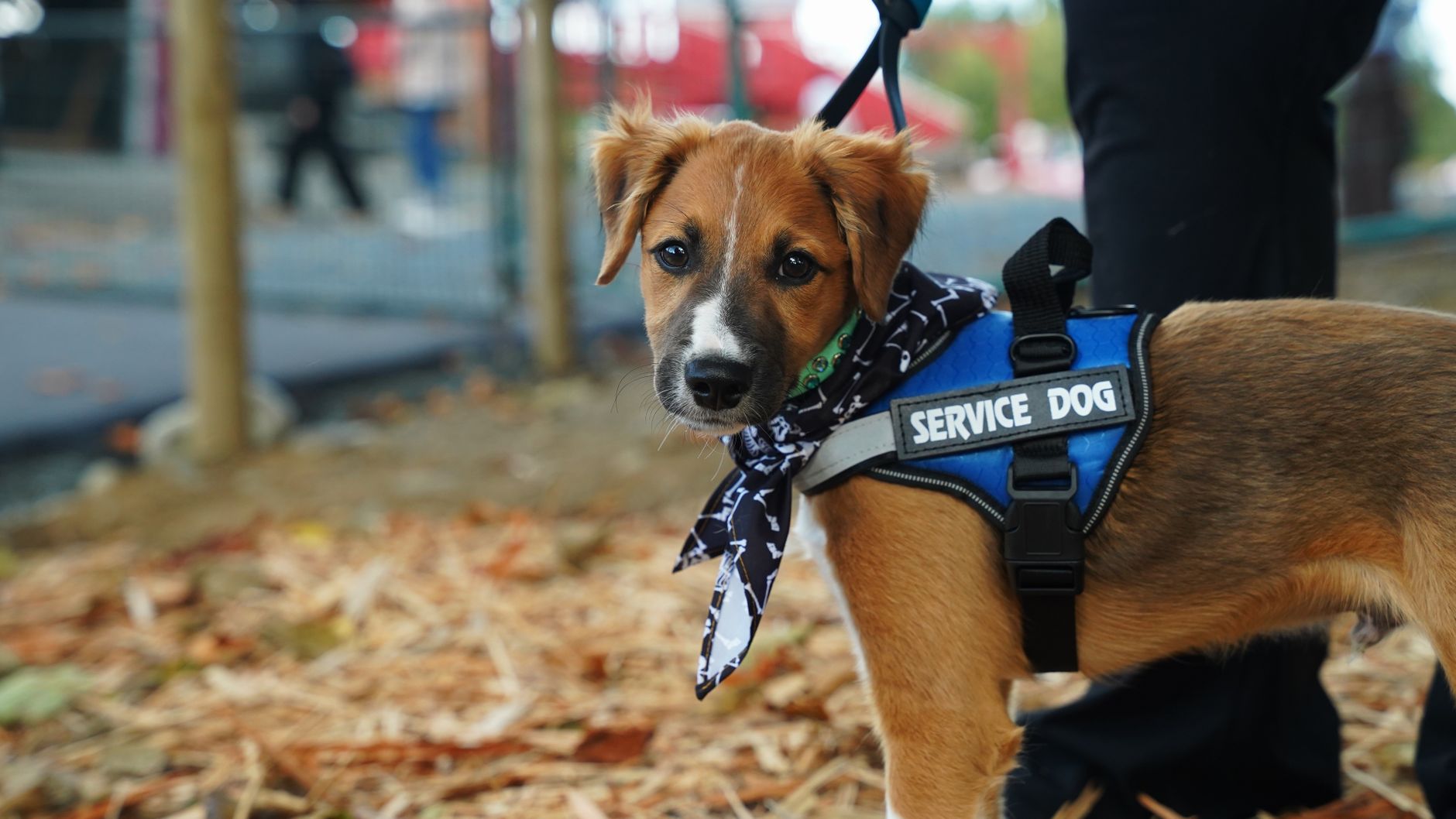
Delta defines a trained service animal as a dog, regardless of breed, that is specifically trained to assist a person with a disability. That wording appears on Delta’s consumer Trained Service Animals page and in Delta’s U.S. Contract of Carriage. Delta’s travel-agency page, dated 12 September 2024, codes these bookings as SVAN and states that Delta only accepts trained service animals in that category.
DOT’s Federal Register final rule published 10 December 2020 (effective 11 January 2021) defines a service animal as a dog, regardless of breed or type, that is individually trained to do work or perform tasks for the benefit of a qualified individual with a disability, including a physical, sensory, psychiatric, intellectual, or other mental disability. Species other than dogs, emotional support animals, comfort animals, companionship animals, and service animals in training are not service animals for that part. Psychiatric service dogs that are task-trained are service animals; DOT’s 2 December 2020 briefing said airlines must treat psychiatric service animals the same as other service animals.
The ADA Requirements page (last updated 28 February 2020) still described the Air Carrier Access Act definition as broader than the ADA; that guidance predates DOT’s December 2020 airline rule. After 11 January 2021, airline cabin access is dogs-only under DOT. ADA.gov states that the Air Carrier Access Act, not the ADA, protects people with disabilities in air travel, and directs airplane complaints to DOT’s Aviation Consumer Protection Division at 202-366-2220.
Does Delta still allow emotional support animals?
No. Delta’s consumer page states that emotional support animals are not recognized as service animals and points handlers to pet-travel rules. On 8 January 2021, Delta Professional announced that beginning 11 January 2021 emotional support animals would no longer be ticketed on any Delta flight. David Garrison, then Delta senior vice president for corporate safety and security, said Delta had seen a nearly 85 percent increase in animal incidents since 2016; that figure is Delta’s 2021 statement, not an independent audit.
How to fly with a Delta service animal
- Confirm the dog is fully trained to perform a disability-related task. Delta says service animals in training are not eligible, except that a dog in training may travel with a professional trainer en route to the owner.
- Book a seat. Delta Professional requires a seat assignment before departure. Do not select an exit row; Delta will reassign an exit-row selection at the gate.
- Complete the U.S. Department of Transportation Service Animal Air Transportation Form (updated September 2024). Knowingly false statements can be a crime under 18 U.S.C. § 1001, as printed on the form. A veterinarian’s name and phone are required; a veterinarian signature is not. DOT estimates about 20 minutes to complete the form.
- If any flight segment is scheduled for eight hours or more, also complete the DOT Service Animal Relief Attestation Form, attesting that the dog will not need to relieve itself on the aircraft or can do so without a sanitation issue.
- Submit the form or forms and a service request to Delta at least 48 hours before departure when the reservation was made more than 48 hours ahead. Check the “Trained Service Animal” box in Delta’s request flow. If you booked within 48 hours, Delta Professional says you may present the documentation at check-in or the gate. DOT’s form instructions say an airline cannot refuse the animal solely for missing the advance window without making reasonable efforts to accommodate the passenger.
- Use one current form per dog. DOT’s instructions say the form may be required once per trip, including a round trip as one trip, and “current” means completed on or after the ticket purchase date.
- For any dog entering or returning to the United States, complete a CDC Dog Import Form before arrival. That CDC receipt is separate from Delta’s DOT paperwork.
Cabin seating, size, and behavior
Delta’s U.S. Contract of Carriage says Delta will accept a service animal without charge; the dog may remain on the floor at the person’s seat and will not occupy a passenger seat. The consumer page adds that the dog may sit on your lap or in your foot space, or in a neighboring foot space if you purchased an additional ticket and that seat is vacant. Animals may not eat from tray tables. Service animals do not count against the carry-on allowance. Delta does not charge fees for trained service animals or their assistive devices, even if checked; a kennel is treated as an assistive device, and essential items such as a bed or food travel free of charge.
If one seat cannot fit you and the dog without obstruction, Delta offers two options: buy an extra ticket so the dog can use that floor space, or check the service animal below the cabin without additional charges. DOT’s 2020 final rule allows airlines to require the animal to fit within the handler’s foot space. A maximum of two service animals may travel with a passenger, matching Delta’s consumer frequently asked questions and the two-animal ceiling in DOT’s 2020 final rule.
Delta lists behavior that can block boarding: growling, biting, lunging, jumping on others, relieving itself outside an approved relief area, barking excessively except in response to a handler’s need, and eating off seatback tray tables. Delta Sky Club access follows the same aircraft behavior rules. Delta lifted its pit-bull-type ban for trained service animals that meet documentation and behavior requirements, according to the January 2021 announcement. DOT’s 2020 briefing said airlines may not refuse a service animal solely based on breed.
Delta service animal versus pet versus ESA
| Category | Who qualifies on Delta | Cabin fee | Main paperwork | Where the animal sits |
|---|---|---|---|---|
| Trained service animal (SVAN) | Task-trained dog assisting a person with a disability, including psychiatric service dogs if task-trained | No pet fee (Delta consumer page and Contract of Carriage) | DOT Service Animal Air Transportation Form; Relief Attestation if the flight is 8 hours or longer; CDC Dog Import Form if entering the United States | Lap or floor footprint; not a passenger seat; not an exit row |
| Emotional support animal (ESA) | Not a service animal on Delta after 11 January 2021 | Same as a pet, if accepted as PETC | Pet-in-cabin booking; CDC rules still apply to dogs entering the United States | Inside an approved kennel under the seat if flying as an in-cabin pet |
| In-cabin pet (PETC) | Small dogs, cats, and (domestic U.S.) household birds that meet size and kennel rules | Delta consumer pet page: $150 USD/CAD each way for U.S./Canada/Puerto Rico/U.S. Virgin Islands tickets issued on or after 8 April 2025; $200 USD/CAD/EUR international | Pet reservation and destination health papers as required | Inside a leak-proof kennel under the seat; Delta recommends about 18 by 11 by 11 inches for most aircraft |
Sources disagree on the U.S. pet fee. Delta’s consumer Pet Travel page lists $150 USD/CAD each way for U.S./Canada/Puerto Rico/U.S. Virgin Islands tickets issued on or after 8 April 2025. Delta Professional pet-policy pages list $200 USD for travel within the United States or between the United States and the U.S. Virgin Islands or Puerto Rico. Use the fare rules on your ticket and the live delta.com pet page at booking.
Age, vaccines, and CDC re-entry
Delta’s consumer service-animal page says all traveling service animals must be fully vaccinated and at least 4 months old. Puppies may be vaccinated for rabies at 3 months old, then a 30-day wait applies before they may fly at 4 months. If the dog is older than 15 months, was previously vaccinated for rabies, and that vaccination has expired, Delta says the dog may fly immediately after a rabies booster without a 30-day wait.
CDC rules for bringing a dog into the United States are separate and apply to service dogs. CDC’s Bringing a Dog into the U.S. page (1 August 2024 import rule) and dog-importation FAQ (updated 28 April 2026) require every dog, including a trained service animal, to appear healthy, be microchipped, be at least 6 months of age, and travel with a CDC Dog Import Form receipt. Additional rabies documents apply if the dog has been in a high-risk country in the prior 6 months. CDC’s Dog Import Form instructions, noting a 5 February 2026 receipt-format update, tell importers to select “Service animal” only if the dog meets 14 CFR 382.3.
Delta’s international pet page also warns that as of 3 August 2026, dogs entering Mexico need a New World screwworm inspection certificate issued by a United States Department of Agriculture Animal and Plant Health Inspection Service (USDA APHIS) accredited veterinarian no more than 5 days before arrival.
International, Hawaii, and the United Kingdom
Delta Professional says acceptance of trained service animals can vary by country. On Delta’s international page: the United Kingdom does not accept live animals as checked or carry-on baggage, but Delta will transport service dogs to London Heathrow, London Gatwick, and Manchester with a pre-approval letter from the destination Animal Reception Centre. For the UK Pet Travel Scheme, Delta points travelers to the Department for Environment, Food and Rural Affairs (Defra). That UK government scheme is not an EU pet passport and is not Animal Passport’s product. Hawaii accepts only trained service animals, with health certificates and rabies vaccinations dated no more than 10 days before travel, and only on flights directly to Honolulu; Delta does not accept warm-blooded animals on flights longer than 12 hours. Cuba, Delta says, does not recognize trained service animals as service animals and treats them as household pets. Australia and New Zealand do not allow pets as carry-on or checked baggage; Delta states the only exception is service animals with correct documentation.
An EU pet passport, which Delta’s international page still discusses under Regulation (EC) No. 998/2003 for non-commercial movement of dogs, cats, and ferrets, is a government veterinary travel document. It is not Delta’s SVAN approval, not the DOT form, and not a biometric livestock identity record.
What Animal Passport is not
None of the airline or government documents above is issued by Animal Passport. Animal Passport is a digital animal and livestock identity product that uses muzzle biometrics (a nose print unique like a fingerprint). Capture is phone-based. The record can bind owner, breed, estimated age, body condition, and vaccination history. Age can be estimated from a dental photograph with a confidence score, and body condition can be scored 1–5 from a side-profile photo. The product was used in livestock flood rescue in Pakistan in August 2025 so farmers could reclaim animals after paper tags washed away. It is not a government-issued travel document, not a substitute for the DOT Service Animal Air Transportation Form, not a CDC Dog Import Form, and not an EU or UK pet passport. Handlers who also keep livestock can read more on the Animal Passport blogs.
Private registries and Complaint Resolution Officials
Delta’s consumer frequently asked questions state that National Service Animal Registry membership does not change Delta’s policies. ADA.gov says a vest is not proof a dog is a service animal. If a problem arises at the airport or onboard, Delta Professional tells agents to send the passenger to a Complaint Resolution Official. Delta’s consumer page lists an accessibility assistance line at 404-209-3434 (711 for relay).
Frequently asked questions
Does Delta allow service animals on planes?
Yes. Delta accepts fully trained dogs as service animals in the cabin at no pet fee when DOT documentation and behavior rules are met, according to Delta’s Trained Service Animals page and U.S. Contract of Carriage.
Does Delta still allow emotional support animals?
No. Delta stopped ticketing emotional support animals on 11 January 2021 after the U.S. Department of Transportation 2020 final rule. An ESA may fly only if it qualifies as an in-cabin pet and a pet space is available.
What forms does Delta require for a service dog?
Delta requires the U.S. Department of Transportation Service Animal Air Transportation Form for every trained service dog. Flights scheduled for eight hours or more also need the DOT Relief Attestation Form. Dogs entering the United States additionally need a CDC Dog Import Form receipt.
How many service animals can you bring on Delta?
Delta permits a maximum of two trained service animals per passenger, matching the DOT 2020 rule that carriers need not accept more than two service animals for a single passenger with a disability.
Does a Delta service animal fly for free?
Yes. Delta’s Contract of Carriage and consumer page state there is no charge to transport a trained service animal or its assistive devices. Buying a second seat for extra floor space is optional and is a ticket purchase, not a pet fee.
Can a service animal in training fly on Delta?
Usually no. Delta says a service animal in training does not qualify, except when a professional trainer is taking the dog to its owner.
Do service dogs need a CDC form to enter the United States?
Yes. CDC’s April 2026 dog-importation FAQ says all dogs entering or returning to the United States, including service dogs, must have a CDC Dog Import Form receipt, be at least 6 months old, be microchipped, and appear healthy.
Can you sit in an exit row with a service dog on Delta?
No. Delta’s consumer page prohibits exit-row seating with a service animal and says an exit-row selection will be reassigned at the gate. Delta Professional says the passenger may otherwise sit anywhere in the purchased cabin, including Delta One, Business, or First Class.
This article is informational reporting by Animal Passport, last updated 19 August 2026. It is not legal advice or veterinary advice. Recheck delta.com, transportation.gov, and cdc.gov before you travel.
FAQ
- Does Delta allow service animals on planes?
- Yes. As of August 2026, Delta Air Lines accepts fully trained dogs as service animals in the cabin at no pet fee when U.S. Department of Transportation forms and behavior rules are met, according to Delta’s Trained Service Animals page and U.S. Contract of Carriage.
- Does Delta still allow emotional support animals?
- No. Delta stopped ticketing emotional support animals on 11 January 2021 after the U.S. Department of Transportation 2020 Air Carrier Access Act final rule. An emotional support animal may fly only if it is accepted as an in-cabin pet under Delta’s pet policy.
- What forms does Delta require for a service dog?
- Delta requires the U.S. Department of Transportation Service Animal Air Transportation Form for every trained service dog. Flights scheduled for eight hours or more also need the DOT Relief Attestation Form. Dogs entering the United States also need a CDC Dog Import Form receipt.
- How many service animals can you bring on Delta?
- Delta permits a maximum of two trained service animals per passenger. That limit matches the U.S. Department of Transportation 2020 rule that a carrier is not required to accept more than two service animals for a single passenger with a disability.
- Does a Delta service animal fly for free?
- Yes. Delta’s U.S. Contract of Carriage and consumer service-animal page state there is no charge to transport a trained service animal or its assistive devices, including a kennel treated as an assistive device. Buying an extra seat for more floor space is optional.
- Can a service animal in training fly on Delta?
- Usually no. Delta’s Trained Service Animals page says a service animal in training does not qualify as a recognized service animal, except that a dog in training may travel with a professional trainer en route to the owner.
- Do service dogs need a CDC form to enter the United States?
- Yes. The Centers for Disease Control and Prevention April 2026 dog-importation FAQ says all dogs entering or returning to the United States, including service dogs, must have a CDC Dog Import Form receipt, be at least 6 months old, be microchipped, and appear healthy.
- Can you sit in an exit row with a service dog on Delta?
- No. Delta’s consumer service-animal page prohibits exit-row seating with a service animal and says an exit-row selection will be reassigned at the gate. The passenger may otherwise sit in the purchased cabin, including premium cabins, according to Delta Professional.
Sources
- Trained Service Animals — Delta Air Lines
- U.S. Department of Transportation Announces Final Rule on Traveling by Air with Service Animals — U.S. Department of Transportation
- U.S. Department of Transportation Service Animal Air Transportation Form (September 2024) — U.S. Department of Transportation
- ADA Requirements: Service Animals — U.S. Department of Justice, ADA.gov
- Frequently Asked Questions on Dog Importations — Centers for Disease Control and Prevention
- Pet Travel on Delta — Delta Air Lines
- International & Connection Pet Travel — Delta Air Lines
- Traveling with Pets and Service Animals, CDC Yellow Book 2026 — Centers for Disease Control and Prevention
Animal Passport binds a muzzle biometric to a digital record farmers, buyers, and insurers can verify in the field.