How to Fly With a Big Dog: Airline Rules, Crates, and Costs
Key takeaways
- Big dogs generally can't fly in the main cabin — the carrier must fit fully under the seat, which rules out almost any dog over roughly 20 lbs.
- As of September 2026, Delta and United have suspended general-public pet cargo/checked shipping; only active-duty military and State Department PCS orders qualify for exceptions.
- Alaska Airlines and American Airlines' PetEmbark manifest-cargo service are the most consistent domestic options for shipping a large dog.
- Crates must meet IATA Live Animals Regulations: rigid construction, spring-locked metal door bolts, and ventilation on at least three sides equal to 16% of each side's surface area.
- A USDA-accredited veterinarian must complete a health certificate (APHIS Form 7001), typically valid only if issued within about 10 days of travel.
- Brachycephalic (snub-nosed) breeds — Bulldogs, Pugs, Boston Terriers, Boxers, Shih Tzus, Pekingese — are banned from cargo by most major U.S. carriers.
- Airlines embargo pet cargo and checked-baggage travel in extreme heat or cold, typically outside a roughly 20°F to 80–85°F range anywhere on the itinerary.
- Budget $150–$200+ each way for checked baggage on the airlines that still offer it, or $400–$1,200+ for manifest cargo or a professional pet-shipping service.
Flying with a big dog means your options narrow to checked baggage or manifest cargo, since only carriers small enough to fit fully under an airplane seat are allowed in the main cabin — a cutoff that excludes almost any dog over roughly 20 pounds. As of September 2026, Delta Air Lines and United Airlines have suspended general-public pet cargo shipping (active-duty military and State Department transfer orders excepted), while Alaska Airlines and American Airlines' PetEmbark cargo service remain the most consistent ways to fly a large dog domestically. This guide covers current airline policies, IATA crate rules, required paperwork, breed and weather restrictions, and realistic costs.
Can a Big Dog Fly in the Cabin? No — Here's Why
Every U.S. airline that allows in-cabin pets requires the carrier to fit entirely underneath the seat in front of you. Delta, for example, recommends a soft-sided kennel no larger than about 18" x 11" x 11" for cabin travel, per Delta's official pet travel policy. That dimension works for small dogs and cats, not for a 40-, 60-, or 90-pound dog. There is no exception for a well-behaved large dog to sit at your feet or occupy a seat unless it is a trained service animal covered under the Air Carrier Access Act — emotional support animals no longer qualify for cabin access under U.S. Department of Transportation rules that took effect in 2021.
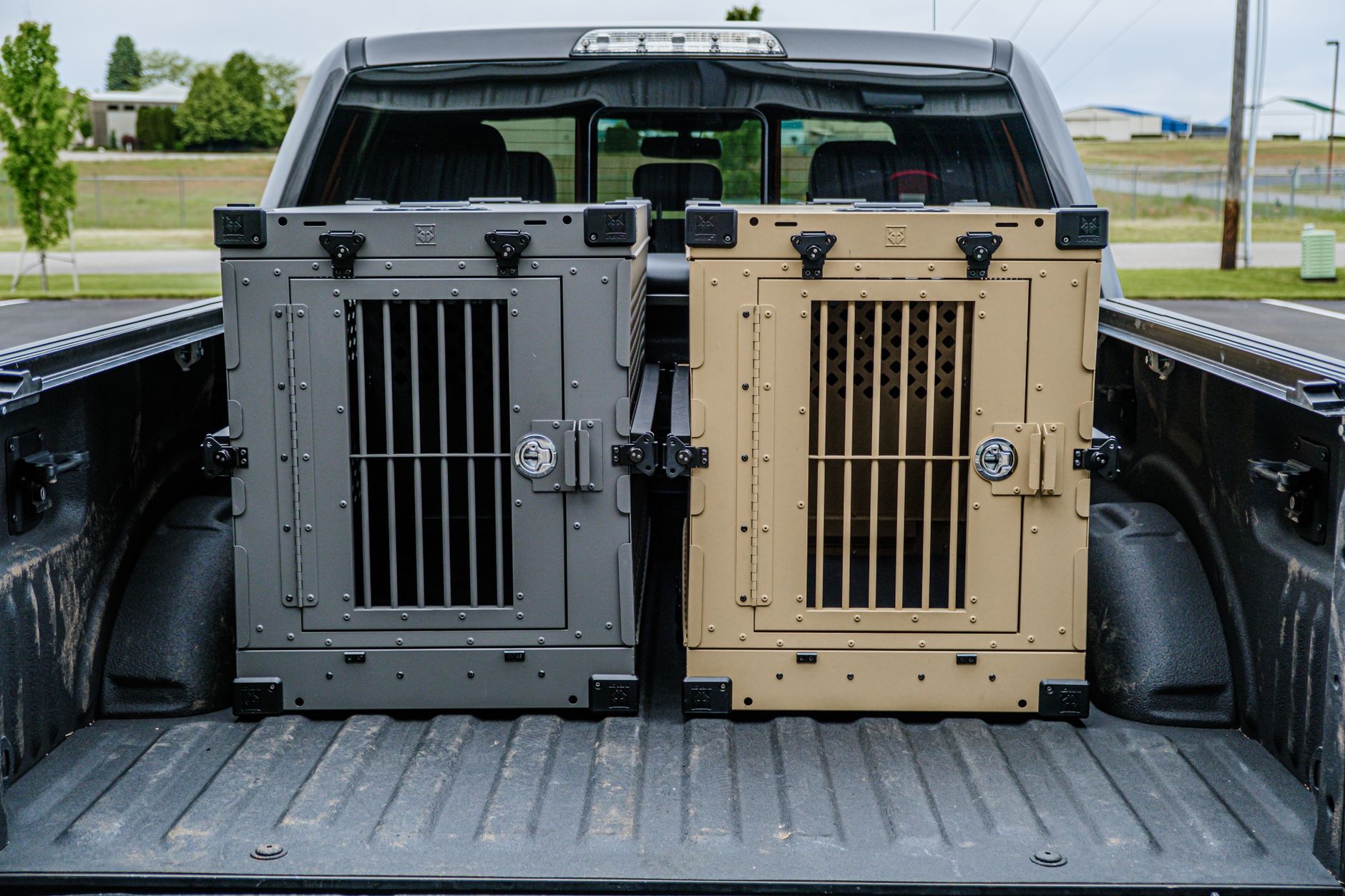

That leaves two paths for a big dog: checked baggage (booked on your own itinerary, riding in the pressurized hold) or manifest cargo (booked separately through an airline's freight division, sometimes without you on the same flight).
Which Airlines Still Accept Large Dogs? (2026 Snapshot)
This is the part that has changed the most since the pandemic: two of the largest U.S. full-service carriers have paused pet cargo for ordinary travelers. Always confirm directly with the airline's cargo division before booking, since embargoes and capacity limits change without notice.
| Airline | Big-dog option | Status (as of September 2026) | Weight/size cap |
|---|---|---|---|
| Alaska Airlines | Checked baggage; Pet Connect cargo for oversized dogs | Operating | 150 lbs combined (dog + crate) |
| American Airlines | PetEmbark manifest cargo | Operating; retail checked-kennel option discontinued for civilians | Varies by crate/route; booked through AA Cargo |
| Delta Air Lines | Checked baggage/cargo | Suspended for the general public; active-duty military & State Dept PCS orders only | N/A while suspended |
| United Airlines | PetSafe cargo program | Discontinued for the general public; military/State Dept exception only | 99.9 lbs combined; crate height ≤ 34" |
Delta's own pet travel pages confirm the suspension is not new or temporary: the carrier states it is "only allowing the shipment of pets for active U.S. Military or U.S. State Department Foreign Service Offices traveling with active permanent change of station orders," per Delta's shipping-your-pet policy page. United's PetSafe cargo program is similarly closed to the public. Practically, that means most owners flying a big dog in the U.S. today are choosing between Alaska Airlines, American Airlines' PetEmbark service, or a professional pet-shipping company.
Manifest Cargo vs. Checked Baggage: What's the Difference?
- Checked baggage: Your dog travels on your ticket, in the same cargo hold as luggage, generally on your flight. This is what Alaska Airlines still offers for dogs up to its combined weight limit.
- Manifest cargo: Your dog is booked as freight through the airline's cargo division (like American's PetEmbark), with separate drop-off and pickup at a cargo facility — not the passenger terminal — and no guarantee of riding on your flight.
IATA Crate Requirements, Step by Step
Over 95% of the world's airlines follow the International Air Transport Association's (IATA) Live Animals Regulations (LAR) for crate construction, even though IATA does not issue an official "IATA-approved" certification or label — a crate is compliant when it meets the published standard, not because a manufacturer stamped a logo on it.
- Choose rigid materials. Fiberglass, metal, rigid plastic, welded wire mesh, or solid wood/plywood only. Soft-sided or fabric crates are never valid for the cargo hold, per IATA.
- Size it to your dog's measurements. IATA's formula sets minimum internal length at nose-to-tail length plus half the elbow height, width at shoulder width times two, and height at standing height plus room to move naturally. Snub-nosed breeds need a container roughly 10% larger.
- Check the door. Metal, with metal hinges and at least two vertical spring-loaded bolts strong enough that the dog cannot force it open.
- Confirm ventilation. Openings on at least three sides, protected by bars or a grille, totaling at least 16% of each ventilated side's surface area.
- Check the floor. Solid, leak-proof, with no gaps that could catch a dog's nails.
- Attach food and water dishes accessible from outside the crate, plus "Live Animal" stickers and this-side-up arrows.
A general-purpose reference many trainers point owners to is the American Kennel Club's (AKC) guide to flying with a dog, which reinforces booking direct flights where possible to reduce handling and layover time.
Paperwork: Health Certificates and Identification
Domestic and international travel both typically require a veterinary health certificate. In the United States, this is the United States Interstate and International Certificate for Health Examination for Small Animals (APHIS Form 7001), completed by a USDA-accredited veterinarian and, for international trips, endorsed by the U.S. Department of Agriculture Animal and Plant Health Inspection Service (USDA APHIS). Airlines commonly require this certificate to be dated within about 10 days of travel, even when a destination country accepts an older one — so book your vet visit close to your departure date, not weeks ahead.
Paper certificates and paper ID tags share a weakness: they can be lost, soaked, or destroyed exactly when an animal is separated from its owner and needs to be identified fastest — during rough handling, a damaged crate, or a natural disaster. That's the same failure mode Animal Passport was built to solve for livestock: a phone-based, muzzle-biometric ID (a nose print is unique, similar to a human fingerprint) that binds an animal's identity to a record independent of any physical tag. During Pakistan's August 2025 livestock floods, when paper ear tags washed away, farmers used Animal Passport's biometric records to reclaim their animals. It's a livestock identity tool, not an airline-recognized travel document — it doesn't replace your dog's USDA health certificate or an airline's required checked-baggage forms — but it illustrates why durable, tamper-proof identification matters whenever an animal travels without you holding the leash. You can read more field examples on the Animal Passport blog.
Breed and Weight Restrictions
Most major U.S. carriers refuse brachycephalic (snub-nosed) breeds in the cargo hold because their airway anatomy makes them prone to overheating and respiratory distress under stress. Commonly restricted breeds include Bulldogs (all types), Pugs, Boston Terriers, Boxers, Shih Tzus, Lhasa Apsos, and Pekingese. Some carriers also restrict pit bull-type breeds specifically for cargo transport. IATA's own guidance is blunt on the underlying risk: "Transport of snub nose dogs, such as boxers, pugs, bulldogs and Pekinese, in hot season is not recommended," because these breeds "have difficulty in maintaining a normal body temperature in hot weather." These restrictions typically apply to cargo and checked baggage, not to in-cabin travel, since a snub-nosed dog small enough for the cabin isn't exposed to the same hold conditions.
Temperature Restrictions
Airlines routinely embargo pet cargo and checked-baggage travel outside a moderate temperature band — commonly when the forecast falls below roughly 20°F or rises above 80–85°F at the origin, destination, or any connecting airport on the itinerary, based on published policy summaries for Delta and United. Summer and winter routings through hot southern or cold northern hub airports are the most common reason a booking gets bumped, so build in flexibility if you're flying in July or January.
How to Book a Flight for Your Big Dog: Step by Step
- Call the airline's cargo or reservations line directly — large-dog bookings are rarely handled through the standard online flow.
- Confirm your dog's breed isn't restricted and that combined dog-plus-crate weight is under the carrier's limit.
- Buy or build an IATA-compliant crate sized to your dog using the formula above, and let your dog acclimate to it for at least a few weeks beforehand.
- Schedule a veterinary exam close to departure so your USDA Form 7001 health certificate falls within the airline's validity window (commonly 10 days).
- Check the weather for every airport on your itinerary, not just your home airport.
- Book a nonstop flight whenever possible to cut down on tarmac time and handling.
- Attach ID — collar tag, microchip number, and a copy of your contact information — to the crate itself, not just your dog.
- Arrive early for cargo drop-off, which is often at a separate freight facility, not the passenger terminal.
What It Costs to Fly a Big Dog
Checked-baggage pricing is the cheapest route where it's still available: Alaska Airlines' published pet fee is in the $150–$200 range each way as of 2026. Manifest cargo and professional pet-shipping services cost substantially more once you factor in cargo-facility handling, crate purchase, and the health certificate — commonly $400 to $1,200 or more for a medium-to-large dog on a domestic route, depending on distance and crate size. For owners who don't want to navigate airline cargo departments themselves, the International Pet and Animal Transportation Association (IPATA) maintains a directory of vetted, independent pet-shipping companies that handle the airline coordination on your behalf — IPATA itself doesn't ship pets, and it warns that no legitimate shipper uses "IPATA" in its own company name, a common scam red flag.
How Safe Is It? What the Data Shows
Under the Animal Welfare Act, U.S. airlines must report to the Department of Transportation any month in which a pet is lost, injured, or dies during air transport. Monthly compilations of these airline-submitted reports, such as those tracked by PetFlight.com, show incidents are infrequent but not zero — for example, PetFlight.com's most recent monthly report noted a single reported death, a French Bulldog traveling in Alaska Airlines cargo, underscoring why brachycephalic breeds face outsized risk even when overall incident counts stay low. Reviewing an airline's recent incident history before booking is a reasonable extra step for large or heat-sensitive breeds.
Don't Confuse a "Pet Passport" With an Airline Travel Document
If you're flying internationally, especially within the European Union, you may see the term "pet passport." This is a specific, official document — not a general travel requirement, and not the same thing as Animal Passport's biometric livestock ID product. Under European Commission rules, the EU pet passport is an EU-standard identification document issued by an authorized veterinarian for dogs, cats, and ferrets moving between EU member states. It records a pet's microchip number, rabies vaccination history, and owner and vet details, and as of 2026 is issued only to EU residents, according to the European Commission's official pet travel guidance. Dogs entering the EU from outside the bloc need a separate animal health certificate instead, not a pet passport. Neither document is issued by an airline, and neither is the same as Animal Passport's biometric ID system, which is a livestock identity tool, not a government-issued EU or U.S. travel credential.
Frequently Asked Questions
Can big dogs fly in the cabin of a plane?
No. U.S. airlines require in-cabin pet carriers to fit fully underneath the seat in front of you, which effectively limits cabin travel to small dogs and cats. Large dogs must fly as checked baggage or manifest cargo instead.
What is the largest dog that can fly on a plane?
It depends on the airline: Alaska Airlines allows up to 150 lbs combined dog-and-crate weight for checked baggage, while United's now-discontinued PetSafe program capped combined weight at 99.9 lbs. Always confirm current limits directly with the airline's cargo division.
Do Delta and United still accept large dogs as cargo?
As of September 2026, both airlines have suspended general-public pet cargo and checked-baggage shipping, with exceptions only for active-duty military and State Department personnel on permanent change of station orders.
What paperwork does my dog need to fly?
Most airlines require a veterinary health certificate — in the U.S., APHIS Form 7001 — completed by a USDA-accredited veterinarian, usually issued within about 10 days of travel, plus proof of current rabies vaccination.
What dog breeds are banned from flying in cargo?
Brachycephalic (snub-nosed) breeds such as Bulldogs, Pugs, Boston Terriers, Boxers, Shih Tzus, and Pekingese are restricted by most major U.S. carriers due to respiratory risk. Some airlines also separately restrict pit bull-type breeds from cargo.
What temperature is too hot or cold for a dog to fly?
Most U.S. carriers embargo pet cargo and checked-baggage travel when temperatures fall below roughly 20°F or rise above 80–85°F at any airport on the itinerary, including layovers.
How much does it cost to fly a large dog?
Checked baggage runs roughly $150–$200 each way where available (such as on Alaska Airlines), while manifest cargo or a professional pet-shipping service commonly costs $400–$1,200 or more depending on route and crate size.
Is a "pet passport" required to fly a dog domestically in the U.S.?
No. The EU pet passport is a European Commission-regulated document for intra-EU travel and isn't used for U.S. domestic flights. U.S. travel instead requires a veterinary health certificate, which is a different document from both the EU pet passport and Animal Passport's biometric livestock ID product.
FAQ
- Can big dogs fly in the cabin of a plane?
- No. U.S. airlines require in-cabin pet carriers to fit fully underneath the seat in front of you, which effectively limits cabin travel to small dogs and cats. Large dogs must fly as checked baggage or manifest cargo instead.
- What is the largest dog that can fly on a plane?
- It depends on the airline: Alaska Airlines allows up to 150 lbs combined dog-and-crate weight for checked baggage, while United's now-discontinued PetSafe program capped combined weight at 99.9 lbs. Always confirm current limits directly with the airline's cargo division.
- Do Delta and United still accept large dogs as cargo?
- As of September 2026, both airlines have suspended general-public pet cargo and checked-baggage shipping, with exceptions only for active-duty military and State Department personnel on permanent change of station orders.
- What paperwork does my dog need to fly?
- Most airlines require a veterinary health certificate — in the U.S., APHIS Form 7001 — completed by a USDA-accredited veterinarian, usually issued within about 10 days of travel, plus proof of current rabies vaccination.
- What dog breeds are banned from flying in cargo?
- Brachycephalic (snub-nosed) breeds such as Bulldogs, Pugs, Boston Terriers, Boxers, Shih Tzus, and Pekingese are restricted by most major U.S. carriers due to respiratory risk. Some airlines also separately restrict pit bull-type breeds from cargo.
- What temperature is too hot or cold for a dog to fly?
- Most U.S. carriers embargo pet cargo and checked-baggage travel when temperatures fall below roughly 20°F or rise above 80–85°F at any airport on the itinerary, including layovers.
- How much does it cost to fly a large dog?
- Checked baggage runs roughly $150–$200 each way where available (such as on Alaska Airlines), while manifest cargo or a professional pet-shipping service commonly costs $400–$1,200 or more depending on route and crate size.
- Is a "pet passport" required to fly a dog domestically in the U.S.?
- No. The EU pet passport is a European Commission-regulated document for intra-EU travel and isn't used for U.S. domestic flights. U.S. travel instead requires a veterinary health certificate, which is a different document from both the EU pet passport and Animal Passport's biometric livestock ID product.
Sources
- Traveler's Pet Corner (Live Animals Regulations guidance) — International Air Transport Association (IATA)
- Pet Travel Overview — Delta Air Lines
- Shipping Your Pet — Delta Air Lines
- United Airlines Pet Policy — PetTravel.com
- How to Fly With a Dog: Airline Policies and Travel Tips — American Kennel Club (AKC)
- International Pet and Animal Transportation Association — IPATA
- Airline Pet Travel Reports — PetFlight.com
- Travelling with a pet within the EU — European Commission