Travel Dog Carrier: What Fits Under the Seat in 2026
Key takeaways
- A travel dog carrier for the cabin must be leak-proof and escape-proof, and the dog must be able to stand, sit erect, turn, and lie down in a natural position.
- IATA Live Animals Regulations Edition 52 (January 2026) does not certify carrier brands; airlines can reject any container that fails Container Requirement 1.
- American Airlines and Delta Air Lines both point to an 18 x 11 x 11 inch soft-sided cabin carrier, but the under-seat space on your aircraft is the real limit.
- IATA requires ventilation on all four sides totaling at least 16 percent; Delta's domestic cabin page allows three sides, so the stricter IATA test is the safer buy.
- Dogs entering the United States after being only in rabies-free or low-risk countries must be at least 6 months old, microchipped, and accompanied by a free CDC Dog Import Form receipt.
- A European pet passport is an official EU identification document. Animal Passport's nose-print livestock record is neither that document nor a travel dog carrier.
A travel dog carrier is a leak-proof, escape-proof container that holds a dog during a trip, usually under an airplane seat. As of September 2026, it must let the dog stand, sit, turn, and lie down, and it must fit the aircraft. The International Air Transport Association (IATA) Live Animals Regulations, January 2026, set the container standard; American Airlines and Delta then set smaller under-seat limits.
The bag is not a travel document. A microchip, a Centers for Disease Control and Prevention (CDC) Dog Import Form receipt, a United States Department of Agriculture (USDA) health certificate, or a European pet passport may travel with the dog. None of those papers replaces the carrier.
What must a travel dog carrier do?
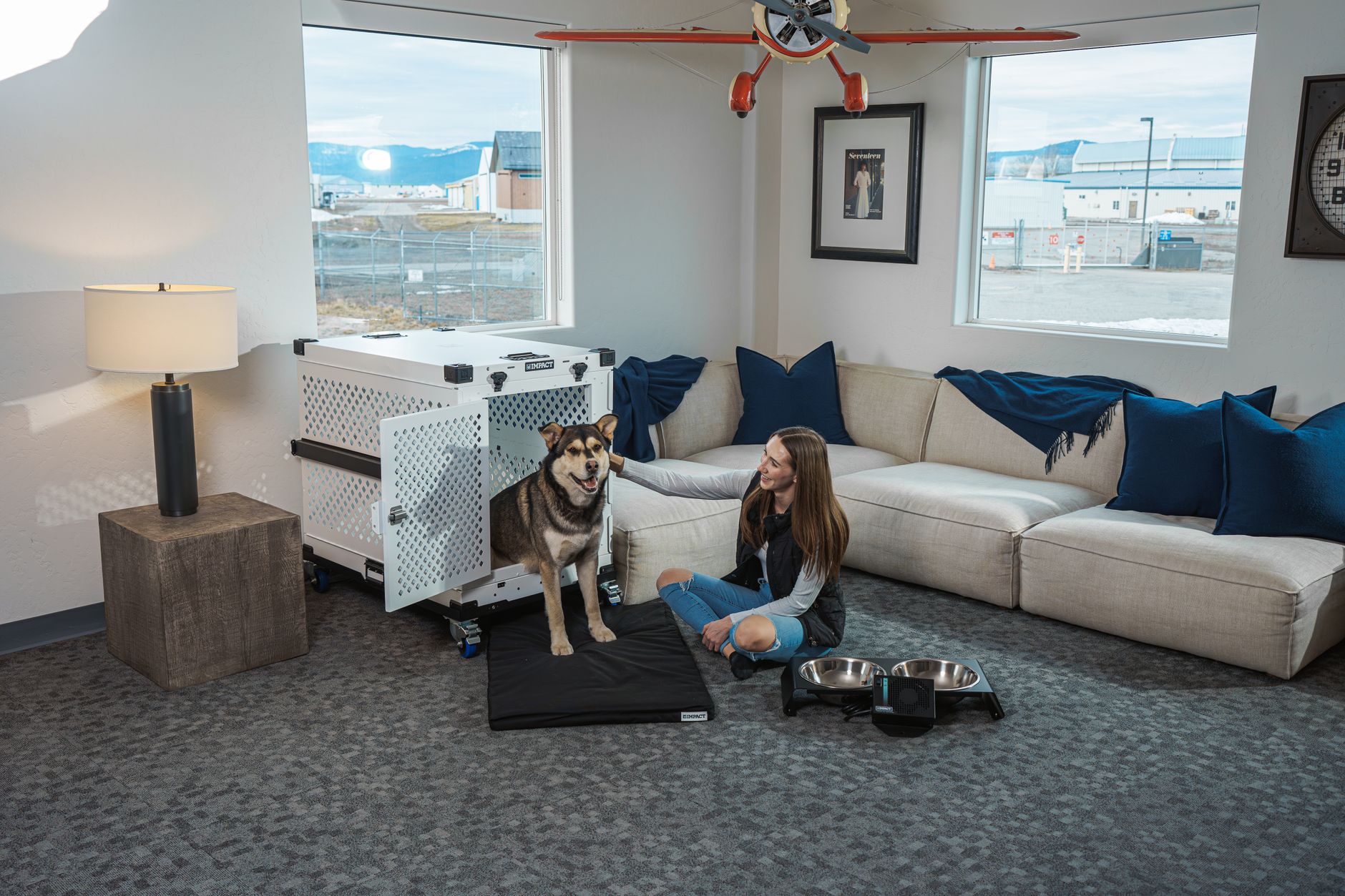
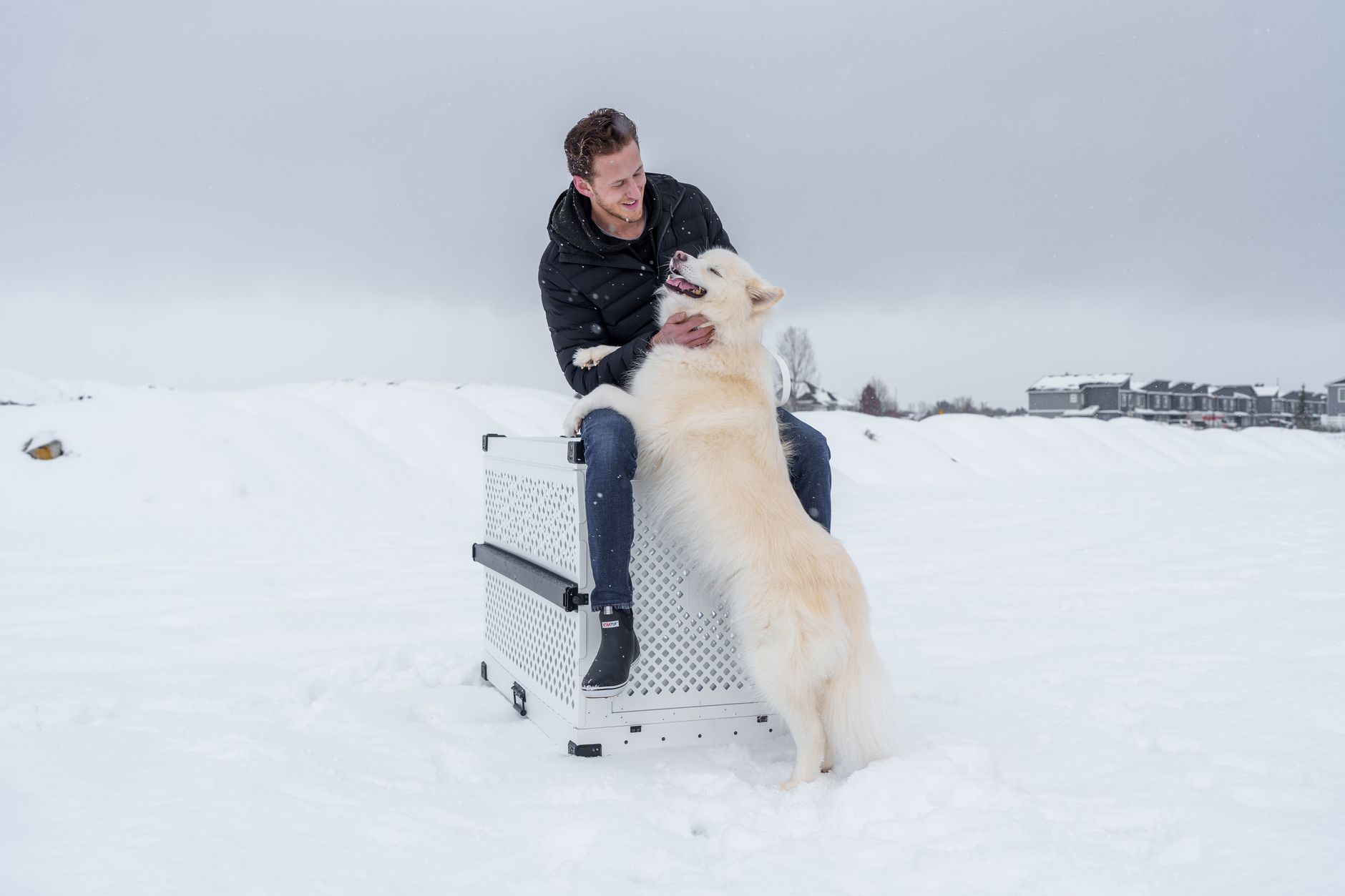
Container Requirement 1 in the International Air Transport Association (IATA) Live Animals Regulations, Edition 52 (January 2026), applies to domestic dogs and cats. Each animal must be able to stand, sit erect, lie in a natural position, and turn about normally while standing. IATA does not certify, approve, endorse, or sell any brand. A tag that says "airline approved" is not an IATA certificate.
In the cabin, four cargo-crate rules are waived. The container need not be rigid. Spacers are not required. Food and water dishes are not required. The welded-wire end used on many shipping crates does not apply to soft cloth bags. The rest still applies, and check-in staff must refuse the animal if the container fails.
Any dog or cat container used for in-cabin carriage of dogs or cats must comply with these standards, or it will be rejected by the airline for travel.
That line is from IATA's Guidance for Passengers Traveling with their Dog or Cat in the Cabin. The guidance says under-seat space is very limited, so only very small dogs will fit, and that compressing a soft bag can block vents and trap heat.
How is a cabin bag different from a cargo kennel?
The United States Department of Agriculture Animal and Plant Health Inspection Service (USDA APHIS), in its Pets on Planes lesson last modified on 25 January 2026, describes the kennel inspected for air transport: hard sided, secure fasteners, sturdy handles, ventilation on three sides and the door, a leak-proof floor with an unused litter pad, and dishes attached inside the door. "Live Animal" labels in 1-inch letters go on the top and at least one side, with upright arrows. That is a cargo or checked kennel, not a purse-style cabin bag.
American Airlines accepts a carry-on pet only if you pay the fee and the pet stays in the carrier under the seat for the whole flight. Checked pets at the American ticket counter are limited to active-duty U.S. military and U.S. State Department Foreign Service personnel on official orders. Delta Air Lines allows small dogs, cats, and household birds in the cabin on domestic flights inside the contiguous United States when age, health, size, and kennel rules are met. Delta also requires the pet to remain in the kennel at the airport and on the aircraft, except in a relief area.
How do you measure the dog?
IATA's January 2026 note uses four measurements. A is nose to tail base. B is ground to elbow. C is shoulder width, or the widest point if that is greater. D is standing height to the top of the head or the ear tip, whichever is higher. Internal length is A plus half of B. Width is C times two. Height is D plus bedding. Snub-nosed breeds need a container 10 percent larger. If that inner box already exceeds the under-seat limit, the dog cannot fly in the cabin on that aircraft. Measure the outside too, including pockets. IATA says wheels must be removed or rendered inoperable.
What size do American and Delta publish?
As of September 2026, American Airlines lists a soft-sided travel dog carrier at 18 x 11 x 11 inches (46 x 28 x 28 centimeters) on all flights. Hard-sided limits are 19 x 13 x 9 inches (48 x 33 x 22 centimeters) on mainline flights and 16 x 12 x 8 inches (40 x 30 x 20 centimeters) on American Eagle. A soft bag may be slightly larger only if it still fits without being crushed onto the dog. Delta recommends the same 18 x 11 x 11 inch soft kennel because it fits most Delta aircraft, and tells you to confirm the seat on your flight.
| Rule | IATA, January 2026 | American Airlines cabin | Delta Air Lines cabin |
|---|---|---|---|
| Fit | Stand, sit erect, lie naturally, turn while standing | Closed carrier fits under the seat | Dog does not stick out; kennel fits fully under the seat |
| Size | Internal formula, not one limit for every breed | Soft 18 x 11 x 11 in. Hard mainline 19 x 13 x 9 in. Eagle 16 x 12 x 8 in. | Recommends soft 18 x 11 x 11 in. |
| Ventilation | At least 16 percent of all four sides | Soft bags: mesh on three or more sides | Three sides domestic; four sides international |
| Cabin fee | IATA does not set passenger fees | $150 per kennel on listed U.S., Canada, Mexico, Central America, and Caribbean trips | $150 each way for U.S., Canada, Puerto Rico, and U.S. Virgin Islands tickets issued on or after 8 April 2025; $200 international |
Ventilation is where the sources disagree. IATA requires openings on all four sides, at least 16 percent of those sides, nose-and-paw proof, no larger than 25 mm by 25 mm for dogs. Delta allows three sides on domestic cabin trips. American's soft-carrier line says mesh on three or more sides. IATA also says an airline may set a stricter rule. A bag that only meets a three-side line can still fail an IATA checklist. Buy for the stricter test.
The seat can void a correct bag. American bars carry-on pets from bulkhead and exit rows, and from First and Business on the Boeing 777-200, 777-300ER, 787-8, and 787-9, which lack under-seat storage. Delta bars bulkhead seats, exit rows, no-stowage seats, flat-bed or Delta One seats, specified Airbus A330 rows, and center seats on the Boeing 757-200.
What will you pay, and where is cabin travel refused?
American lists the carry-on pet fee at $150 per kennel, each way, for trips within and between the United States, Canada, Mexico, Central America, and the Caribbean, and says the fee is nonrefundable. Delta lists $95 USD or CAD for U.S., Canada, Puerto Rico, and U.S. Virgin Islands tickets issued before 8 April 2025, and $150 on or after that date. International is $200. Brazil is $75 before 8 April 2025 and $200 afterward. Delta cabin spaces are first come, first served; have the kennel dimensions when you call.
American allows the carrier plus either one personal item or one carry-on, not both. Delta allows the kennel plus one of those items. Delta's exception list bars in-cabin pets to or from destinations that include Australia, Barbados, Hong Kong, Iceland, Jamaica, New Zealand, South Africa, the United Kingdom, and the United Arab Emirates. It also bars pets originating in Brazil, Colombia, or the Dominican Republic, and bars pet travel on flights to Hawaii.
What happens at security and on the aircraft?
The Transportation Security Administration (TSA) says to take the pet out of the carrying case, send the empty case through the X-ray, and control the pet with a leash. Remove the leash if you carry the pet through the metal detector. The carrier may be inspected visually or by hand. Do not send the dog through the X-ray.
IATA says to introduce the dog to the container well before the trip. Feed a light meal at least two hours before the flight, then give a short drink and a walk immediately before crating. Do not open the carrier in flight. Absorbent bedding is required because the bag must hold urine or feces. Do not sedate the dog to force a fit. IATA's passenger guidance advises against tranquilizers because they blunt the animal's response to stress, and an airline may refuse a sedated dog. Container Requirement 1 adds that many of those drugs lower blood pressure while cabin altitude is already about 8,000 feet, a mix IATA calls potentially fatal in old, chronically sick, or stressed animals. American Airlines does not accept sedated or tranquilized pets and cites the American Veterinary Medical Association.
How old does the dog have to be?
Use the strictest age on the route, because the numbers disagree. IATA bars unweaned animals and animals under 8 weeks from the cabin. USDA APHIS requires dogs and cats to be at least 8 weeks old and fully weaned. American uses 8 weeks within the United States and Puerto Rico. Delta uses 8 weeks for domestic travel, 15 weeks for travel to the European Union, and 6 months for a dog traveling to the United States from another country.
CDC entry is stricter than the 8-week airline floor. For dogs that have been only in dog-rabies-free or low-risk countries, rules in effect since 1 August 2024 require the dog to appear healthy, to be at least 6 months old, and to carry a microchip a universal scanner can read. The CDC document in that case is the Dog Import Form. The receipt is free, covers one dog, and lasts six months if the departure country does not change. Show it to the airline before boarding and to U.S. Customs and Border Protection on arrival. A CDC page dated 28 April 2026 says the receipt layout changed on 5 February 2026 without changing the import rules.
American's page uses a different number for a different group: dogs from high-risk rabies countries must be at least 16 weeks old, in American's words. That does not match the CDC's 6-month rule for rabies-free and low-risk countries. Do not treat the 16-week line as CDC policy. If the dog has been in a high-risk country, read the current CDC high-risk page before you buy the ticket.
A short nose is a health limit. USDA APHIS warns that brachycephalic dogs, including the Boston Terrier, Boxer, English Bulldog, French Bulldog, Pug, and their crosses, face more heat-stroke and breathing risk. IATA already wants their container 10 percent larger. For cargo-style acceptance, USDA APHIS says a veterinarian should sign a health and acclimation certificate within 10 days, including the temperature range, and the owner must state that food and water were offered within 4 hours of airport delivery. On international export, the APHIS pet-travel overview last modified 18 June 2026 says the original endorsed certificate must travel with the pet. Destination officials will not accept an electronic copy.
Which papers are not the carrier?
A European pet passport is an identification document, not a bag. The European Commission's Your Europe service says it follows an EU model, is mandatory between EU countries, and is issued only to EU-resident owners by an authorised veterinarian. It records the microchip, or a readable tattoo applied before 3 July 2011, plus rabies vaccination and the owner and vet. It stays valid for life only while rabies cover is in date. From a non-EU country, Your Europe requires an EU animal health certificate issued by an official state veterinarian not more than 10 days before arrival. Since 1 January 2021, EU pet passports issued to owners resident in Great Britain are not valid for travel from Great Britain to an EU country or to Northern Ireland. The dog must be microchipped before rabies vaccination, be at least 12 weeks old at the first dose, and then wait at least 21 days.
Animal Passport, which publishes this article, is a different product again. It is a digital livestock-identity record using muzzle biometrics: a nose print taken on a phone, unique in the way a fingerprint is unique. The record can bind owner, breed, estimated age, body condition, and vaccination history. Age is estimated from a dental photograph and shown with a confidence score. Body condition is scored from 1 to 5 using a side-profile photo. That is not a diagnosis, not a cabin bag, and not a government travel document. In Pakistan flood rescue in August 2025, it was used so farmers could reclaim livestock after paper tags washed away. More of that record is on the Animal Passport journal. A dog in a commercial cabin still needs a compliant travel dog carrier plus the airline, IATA, CDC or USDA APHIS, and EU rules where they apply.
What should you check before you buy?
- Take the strictest age: 8 weeks on many U.S. domestic flights, 6 months for CDC entry from a rabies-free or low-risk country, and the EU 21-day rabies wait if you are entering the Union.
- Calculate IATA's internal size from A, B, C, and D, then add bedding and, for a snub-nosed dog, 10 percent.
- Compare that box with every aircraft on the ticket. The 18 x 11 x 11 inch soft size is a starting point. The smallest under-seat space wins.
- Pick a leak-proof, escape-proof bag with ventilation on all four sides. Lock or remove wheels. Add bedding and a Live Animals label that does not cover vents.
- Practice in the closed carrier before travel day, reserve the pet seat, and pay the fee for your ticket date.
- Keep the CDC receipt, microchip number, and any original health certificate in hand. At TSA, the dog comes out and the empty carrier goes through the X-ray.
As of September 2026, the travel dog carrier that clears the gate is the one that passes IATA's stand, sit, turn, and lie test and the tightest under-seat limit on your flights.
Frequently asked questions
What size travel dog carrier do airlines allow in the cabin?
American Airlines lists a soft-sided maximum of 18 x 11 x 11 inches, and Delta recommends that size for most aircraft. The dog must still stand, sit, turn, and lie down, and the bag must fit your specific under-seat space.
Are soft-sided travel dog carriers allowed?
Yes. IATA's January 2026 cabin rules say the container need not be rigid, and both American and Delta recommend soft-sided cabin carriers, provided they stay leak-proof, escape-proof, and ventilated.
Can two dogs share one carrier?
Usually no. USDA APHIS allows one dog per kennel, with an exception for two comparable puppies aged 8 weeks to 6 months and weighing 20 pounds (9 kg) or less. Delta allows two young pets of the same breed and size in that window and charges them as one pet.
Do I remove my dog at airport security?
Yes. TSA says to remove the pet, X-ray the empty carrier, and keep the dog under your control. Never put the dog through the X-ray.
Is a travel dog carrier a pet passport?
No. The carrier is the bag. A European pet passport is an official EU identification document. Animal Passport's nose-print livestock record is neither that document nor a government travel pass.
FAQ
- What size travel dog carrier do airlines allow in the cabin?
- As of September 2026, American Airlines lists a soft-sided maximum of 18 x 11 x 11 inches (46 x 28 x 28 centimeters) on all flights, and Delta Air Lines recommends the same size because it fits most aircraft. The carrier must still fit fully under the seat on your specific plane, and the dog must be able to stand, sit, turn, and lie down inside it.
- Are soft-sided travel dog carriers allowed on planes?
- Yes. IATA Container Requirement 1, January 2026, says an in-cabin container does not have to be rigid, and both American Airlines and Delta Air Lines recommend soft-sided carriers for cabin pets. The bag must still be leak-proof, escape-proof, and ventilated, and IATA warns that compression under the seat can block ventilation.
- How do you measure a dog for a travel carrier?
- IATA's January 2026 formula uses nose to tail base (A), ground to elbow (B), shoulder width (C), and standing height (D). Internal length is A plus half of B, width is twice C, and height is D plus bedding. Snub-nosed breeds need a container about 10 percent larger.
- Can two small dogs share one travel dog carrier?
- Usually no. USDA APHIS states that usually only one dog is allowed in each kennel, with a limited exception for two puppies that are 8 weeks to 6 months old, of comparable size, and 20 pounds (9 kg) or less. Delta Air Lines allows two young pets of the same breed and size in one kennel only in that age window, and charges them as one pet.
- Do I remove my dog from the carrier at airport security?
- Yes. The Transportation Security Administration instructs passengers to remove the pet from the carrying case, send the empty case through the X-ray machine, and keep control of the pet. Never put the dog through the X-ray; carriers may receive a visual or physical inspection.
- Is a travel dog carrier the same thing as a pet passport?
- No. A travel dog carrier is the physical bag or crate, while a European pet passport is an official identification document issued by an authorised veterinarian for dogs, cats, and ferrets traveling between European Union countries. Animal Passport, a phone-based livestock identity record that uses nose-print biometrics, is not a government travel document and is not a carrier.
- Should I sedate my dog before putting it in a travel carrier?
- No. IATA's passenger guidance advises against sedation for dogs traveling in the cabin because those drugs can reduce the animal's ability to respond to stress. American Airlines states that it does not accept pets that have been sedated or tranquilized, citing the American Veterinary Medical Association.
Sources
- Container Requirement 1 for Dogs and Cats, IATA Live Animals Regulations — International Air Transport Association (IATA)
- Guidance for Passengers Traveling with their Dog or Cat in the Cabin — International Air Transport Association (IATA)
- Pets on Planes Lesson 1: Preparing and Receiving Pets for Air Travel — USDA Animal and Plant Health Inspection Service (USDA APHIS)
- Pet Travel Process Overview — USDA Animal and Plant Health Inspection Service (USDA APHIS)
- Traveling with Pets — American Airlines
- Pet Travel Overview — Delta Air Lines
- Can I take my pet through the security checkpoint? — Transportation Security Administration (TSA)
- Entry Requirements for Dogs from Dog-Rabies Free or Low-Risk Countries — Centers for Disease Control and Prevention (CDC)
- CDC Dog Import Form and Instructions — Centers for Disease Control and Prevention (CDC)
- EU rules on travelling with pets and other animals in the EU — European Commission
Animal Passport binds a muzzle biometric to a digital record farmers, buyers, and insurers can verify in the field.