Cattle Identification Methods: Ear Tags, EID, Brands, Tattoos and Muzzle Prints
Key takeaways
- No single method does everything. Extension specialists recommend pairing an easy-to-read mark (a tag) with a permanent one (a tattoo or brand). (University of Arkansas Extension)
- US federal rule: Official ear tags applied on or after November 5, 2024 must be both visually and electronically readable for covered cattle and bison moving interstate. (Federal Register, 89 FR 39540)
- Who is covered: sexually intact cattle and bison 18 months or older, all dairy cattle, and cattle or bison of any age used for rodeos, shows, exhibitions or recreational events. (USDA APHIS)
- Who is not: beef feeder cattle under 18 months, cattle going directly to slaughter, and cattle that never leave their state. (Ohio State University Extension)
- EID tags are free from your State Veterinarian's office, or you can buy them from approved manufacturers. (APHIS FAQ)
- Muzzle prints are unique to each animal, like a human fingerprint. Published studies report 97–99.5% identification accuracy under research conditions, but muzzle prints are not an official ID method under US federal rules.
Published: 26 November 2026. Last checked: 26 November 2026.
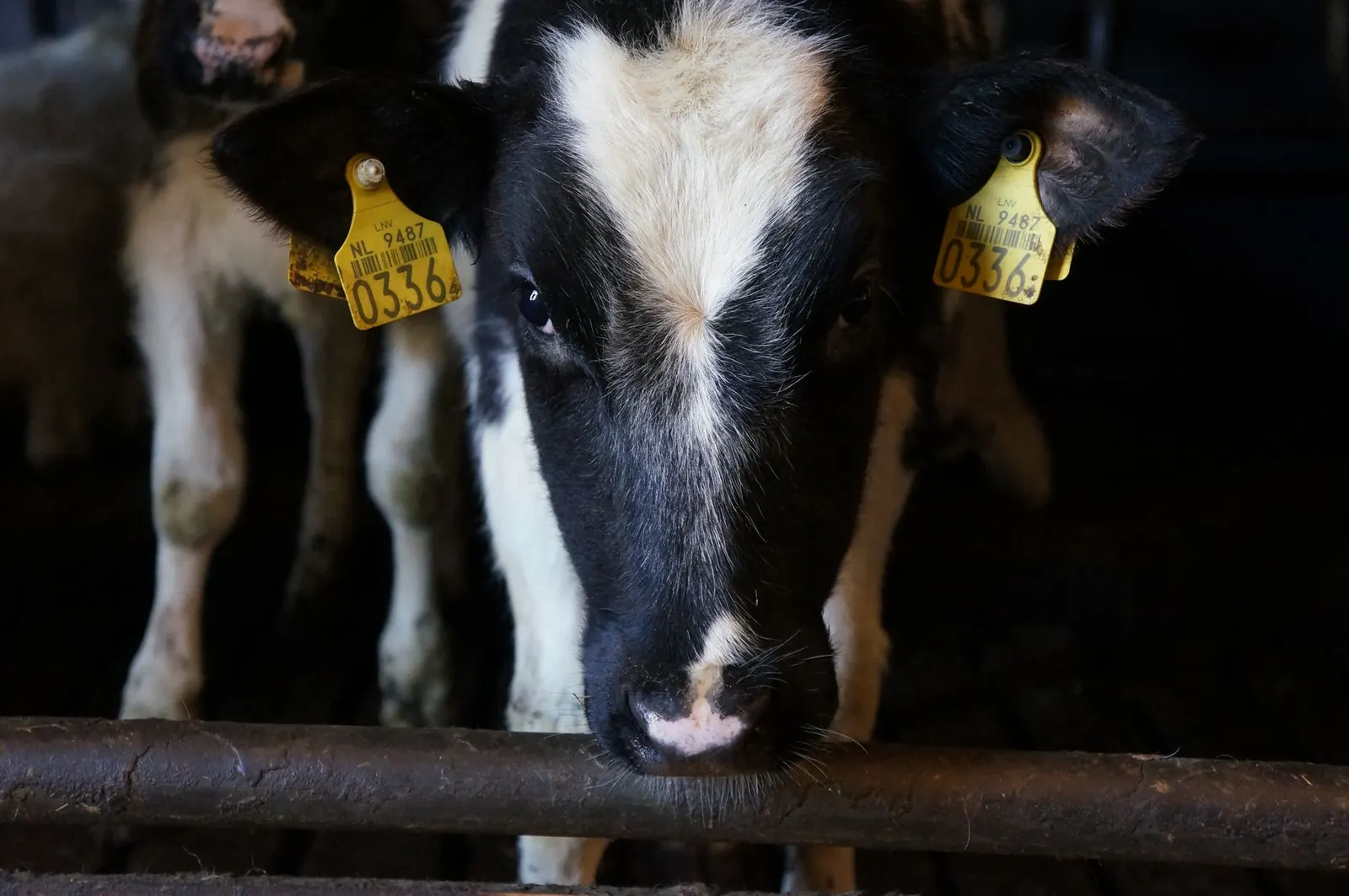
Quick answer: Cattle are identified with ear tags (visual or electronic), hot-iron or freeze brands, ear tattoos, ear notches, and biometrics such as muzzle prints. In the United States, certain cattle moving across state lines must carry official identification. Since November 5, 2024, any new official ear tag must be both visually and electronically readable (EID). Most farm advisors recommend combining two methods: one that is easy to read and one that is permanent.
This guide compares every method on cost, permanence and readability. It also covers what the USDA rules actually require and what peer-reviewed research shows about muzzle-print identification.
Why cattle identification matters
Identification is the foundation of every herd record. Without knowing which animal is which, you cannot track calving dates, weaning weights, vaccinations, treatments, milk yield or breeding decisions.
It also matters beyond the farm. If a disease such as foot-and-mouth disease reaches a country, animal health officials need to know where infected and exposed animals have been. APHIS describes traceability as not preventing disease, but making it possible to locate at-risk animals quickly and limit the number of herds affected. (Federal Register)
How officials use identity when livestock cross a border is covered in animal quarantine for livestock.
Identification serves three separate jobs, and different methods suit each one:
- Ownership: proving the animal is yours (brands have done this job for centuries).
- Individual management: telling cow 214 from cow 215 at the chute, in the parlor or across the pasture.
- Official traceability: meeting government rules when cattle move off the farm or across borders.
Cattle identification methods compared
| Method | Permanent? | Readable from a distance? | Official ID in the US? | Typical drawback |
|---|---|---|---|---|
| Visual (plastic) ear tag | No, can be lost | Yes | No (management tag only) | Tags tear out, fade or get dirty |
| Official visual tag (metal/NUES) | Mostly | No | Only if applied before Nov 5, 2024 | Small, hard to read without restraint |
| EID / RFID ear tag | Mostly | With a reader, yes | Yes | Needs a reader and software to get full value |
| Hot-iron brand | Yes | Yes | Only with brand inspection certificate and state agreement | Painful; damages the hide |
| Freeze brand | Usually | Yes (on dark hides) | Same as hot-iron brand | Less effective on white or light hides |
| Ear tattoo | Yes | No (animal must be restrained) | Only with breed registration certificate and state agreement | Must be read in the head gate |
| Ear notching | Yes | Partly | No | Limited number range; disfigures the ear |
| Rumen bolus (electronic) | Yes | With a reader | No | Must be recovered at slaughter |
| Muzzle-print biometrics | Yes (natural) | With a camera | No | Not a regulatory method; needs good images |
The sections below explain each method in more detail.
1. Ear tags
Ear tags are the most common way to identify cattle. In the most recent USDA NAHMS beef study to report this breakdown (2007–08), plastic ear tags were used on 50.4% of beef operations, far ahead of any other method. (USDA APHIS NAHMS) That data is old, and electronic tags have spread a lot since then, but tags are still the default.
Visual management tags
These are the large, colored plastic tags you write a herd number on. They are cheap, weather-resistant and easy to read across a pen. (University of Illinois Extension)
Their weakness is retention. Tags tear out on fences and feeders, fade in the sun and get covered in mud. Illinois Extension recommends using a second method alongside them for exactly this reason. Many producers use tag color for the birth year and the number for birth order. This system helps, but a management tag is not official ID.
Official visual tags (metal "Brite" or NUES tags)
For decades, animal disease programs used small metal tags with an official number. Under the current rule, an official visual-only tag applied before November 5, 2024 remains official ID for the rest of that animal's life. (NC Department of Agriculture) Any new official tag must be electronic.
Electronic identification (EID / RFID) tags
EID tags carry a unique number that a handheld or panel reader picks up by radio frequency, and the same number is printed on the tag. Two technologies are common: half duplex (HDX) and full duplex (FDX). Canada, for example, approves low-frequency RFID tags using both. (Canadian Cattlemen's Association)
Advantages: - Scanning is faster and less error-prone than writing down 15-digit numbers by hand at the chute. - Readings can feed straight into scales, herd software and movement records. - They meet the current US official ID requirement for covered cattle.
Disadvantages: - You need a reader (or access to one at the sale barn or vet) to benefit fully. - Tags can still be lost. When you replace an official tag, you must record the date, the new number and the old number if known, and keep that record for five years. (APHIS FAQ) - Cost: USDA's own analysis put the added cost at roughly $3 per head. (Beef Magazine) APHIS offsets part of this by supplying free tags through State Veterinarians.
Tagging tip: Place the tag in the middle third of the ear, between the cartilage ribs, and keep applicators clean. Record each tag number in your herd records before the animal leaves the chute.
2. Branding
Branding is the oldest form of cattle identification and is still the legal proof of ownership in many Western states. Arizona Extension notes that brands primarily establish ownership under state law. (University of Arizona Extension)
Hot-iron branding
A heated iron destroys the hair follicles and leaves a permanent, hairless scar. University of Florida Extension notes that hot-iron brands work on all breeds and hide colors. A correct brand shows a saddle-leather (copper) color. If the brand looks black, the iron needs to be reapplied. (UF/IFAS Extension)
Pros: permanent, readable at a distance, accepted for ownership. Cons: painful, damages the hide, and requires good restraint.
Freeze branding
Irons are chilled in liquid nitrogen, or in dry ice and alcohol. The cold kills the pigment-producing cells but leaves the hair follicles alive, so the hair grows back white. (UF/IFAS Extension)
- Works best on black, red and other dark-hided cattle. (University of Missouri Extension)
- Causes less hide damage and pain than hot-iron branding.
- The American Angus Association notes it works best in spring and fall, when hair follicles are most active. (Angus University fact sheet)
- Hot-iron brands are generally more likely to last the animal's lifetime. (University of Missouri Extension)
Brands as official ID: A brand counts as official ID for interstate movement only if it is registered with a recognized brand inspection authority, travels with an official brand inspection certificate, and both the shipping and receiving states agree. (9 CFR 86.4)
3. Ear tattoos
A tattoo plier punches numbers or letters into the inside of the ear, and ink is rubbed into the wounds. The result is permanent and cannot fall out, which is why many breed associations require tattoos for registration.
The trade-off is readability. A tattoo can only be read with the animal restrained in a head gate, often with a flashlight. (University of Missouri Extension) The classic combination is a tag for daily reading plus a tattoo as a permanent backup. If the tag is lost, you read the tattoo at the chute and apply a new tag with the same number. (University of Arkansas Extension)
Tattoos as official ID: Tattoos accepted by a breed association can serve as official ID when the animal travels with its breed registration certificate and both states agree. (APHIS FAQ)
4. Ear notching
Ear notching cuts a coded pattern of V-shaped notches into the ear edges. It is standard in the swine industry and is sometimes used in cattle herds alongside tags. (Purdue Extension) It is permanent and needs no equipment beyond a notcher. However, it supports only a limited range of numbers and permanently changes the ear.
5. Electronic boluses, collars and other devices
- Rumen boluses are ceramic-coated RFID capsules swallowed into the forestomach. They are tamper-proof and cannot be lost on a fence, but they must be recovered at slaughter.
- Neck chains and collars, often with activity or rumination sensors, are common in dairies for parlor sorting and heat detection.
These are management tools, not US official ID.
6. Muzzle-print biometrics
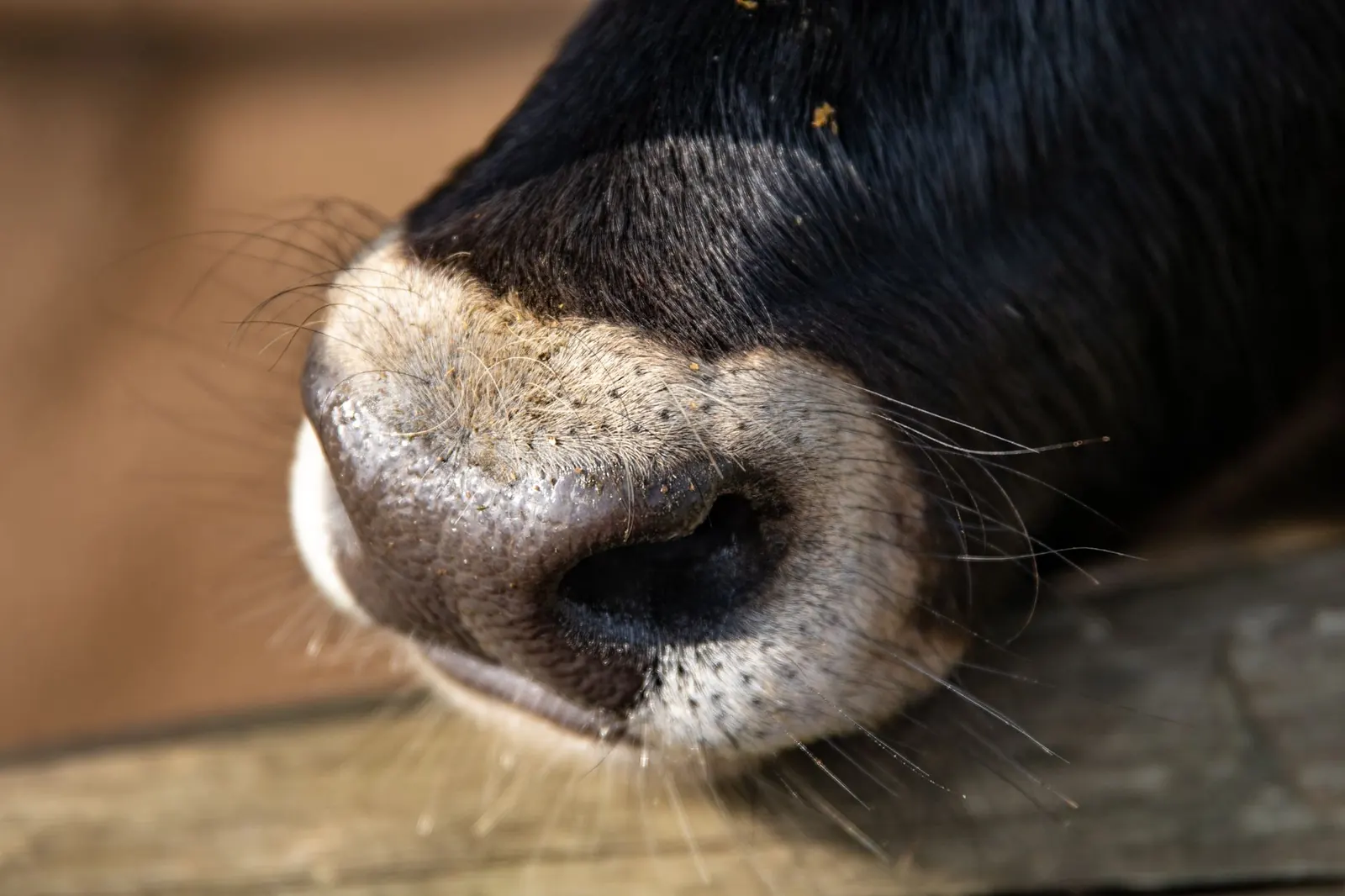
Every cow's nose (muzzle) has a pattern of ridges and grooves, which researchers call a dermatoglyphic trait, the same category as a human fingerprint. (Li et al., Animals, 2022) Because the pattern is unique to each animal and does not need to be attached or applied, muzzle identification is non-invasive. You photograph the nose, and software matches it against a database.
What the research shows
Recent peer-reviewed and preprint studies using deep learning report high accuracy:
| Study | Animals / images | Best reported accuracy |
|---|---|---|
| Li, Erickson & Xiong, Animals (2022) | 268 beef cattle; 59 models tested | 98.7%, at 28.3 ms per image (source) |
| Shojaeipour et al., Agronomy (2021) | Mixed-breed cattle; few-shot learning | 99.13% muzzle detection, 99.11% identification (source) |
| Kimani & Busogi, arXiv preprint (2023) | 4,923 images from 268 beef cattle | 99.5% (wide ResNet50) (source) |
| Journal of Dairy Research (2024), Vrindavani crossbred cattle | 2,640 images | 97.22% with a model under 4 MB (source) |
Two points stand out:
- Accuracy is consistently high. Across different breeds, countries and model types, published results cluster between about 97% and 99.5%.
- Models are getting small enough for phones. The Journal of Dairy Research study used a model under 4 MB, which makes on-farm, on-phone identification practical.
Limits to be honest about
- Research conditions ≠ field conditions. Most studies use clean, well-lit, close-up images. Mud, feed, nasal discharge and a moving animal make real-world capture harder. The Australian team behind the Agronomy study notes that reaching the very high accuracy needed for large, diverse herds remains a major challenge. (Shojaeipour et al.)
- It is not official ID in the US. Under 9 CFR 86.4, official ID for cattle means official ear tags, qualifying brands, qualifying tattoos or group/lot numbers. Biometric measurements are mentioned only in the description of horses and other equids. (9 CFR 86.4) A muzzle print can't replace an EID tag for interstate movement.
Where muzzle ID is useful
Muzzle identification works best as a second, permanent layer: - Lost tags: confirm which animal lost its tag before you retag it, so your records stay correct. - Disputes and verification: match an animal to its records when ownership or identity is questioned, for example at sale, insurance or loan time. - Herds with no tagging infrastructure: small farms can build individual records with nothing more than a phone. - Animal welfare: no ear wound, no burn, no restraint beyond a steady head.
This is what we build at Animal Passport: muzzle-print identification on a phone, linked to each animal's health and production record. We designed it to work alongside your official tags, not to replace them.
US rules: which cattle need official identification?
The federal Animal Disease Traceability (ADT) rule at 9 CFR Part 86 applies only to interstate movement. (South Dakota Animal Industry Board) Your state may have its own rules for movement inside the state.
Covered classes (must be officially identified to move interstate): - Sexually intact cattle and bison 18 months of age or older - All dairy cattle, of any age - Cattle and bison of any age used for rodeo or recreational events - Cattle and bison of any age used for shows or exhibitions
Not covered: beef feeder cattle under 18 months, cattle moving directly to slaughter (including culls), and cattle that do not move interstate. (Ohio State University Extension)
Paperwork: Covered animals moving interstate generally also need an interstate certificate of veterinary inspection (ICVI) or other approved movement document, and the ID numbers must be recorded on it. (APHIS cattle ADT decision tree)
Accepted official ID methods for cattle and bison (APHIS FAQ): 1. An official ear tag. Any tag applied on or after November 5, 2024 must be visually and electronically readable. 2. A registered brand with an official brand inspection certificate, when both states agree. 3. A breed-registry tattoo with the registration certificate, when both states agree. 4. Group/lot identification, for animals managed together as one group through the production chain.
Where do you get EID tags? Contact your State Veterinarian's office for free tags, or buy approved tags from manufacturers and distributors. (APHIS FAQ)
Legal status (as of November 2026): The EID rule took effect on November 5, 2024 and remains in force. A lawsuit filed on October 30, 2024 by R-CALF USA, the South Dakota Stockgrowers Association and the Farm and Ranch Freedom Alliance is still pending in federal court in South Dakota. The case was paused in mid-2026 for settlement talks, but those talks failed and the case resumed in October 2026. (Rapid City Post; Capital Press) Check APHIS's traceability page before you ship.
Canada: tag before leaving the farm of origin
Canada's system is stricter than the US federal rule. Cattle, bison and sheep must carry an approved tag before they leave their farm of origin. If you dispose of a tagged animal on the farm, you must report it to the Canadian Cattle Identification Agency (CCIA) within 30 days. (Canadian Food Inspection Agency) The approved tags are low-frequency RFID tags using HDX or FDX technology. (Canadian Cattlemen's Association)
How to choose an identification system for your herd
Use this decision path:
- Do any of your cattle cross state lines (breeding stock, dairy animals, show cattle)? If yes, you need official ID. For new tags, that means EID. Order free tags through your State Veterinarian.
- Do you need to read IDs from a distance (pasture checks, calving)? Add a large visual management tag with matching numbers.
- Do you need permanent backup ID (registered stock, high-value animals, lost-tag problems)? Add a tattoo, a freeze brand on dark cattle, or a hot-iron brand.
- Do you need to prove ownership in a brand state? Register a brand with your state brand authority.
- Do you want non-invasive individual records without extra hardware? Add muzzle-print identification as a digital layer tied to your herd records.
A practical setup for most cow-calf herds: an EID tag in one ear, a matching visual tag in the other, and one permanent method (a tattoo, a freeze brand or a muzzle-print record). If a tag goes missing, the permanent method lets you restore the same ID.
A simple numbering system
Many herds use a four-digit number in which the first digit is the birth year and the rest is the birth order. Calf 10 born in 2026 becomes 6010. The Beef Improvement Federation also assigns a letter to each year (the letters I, O, Q and V are skipped, so 2025 is N and 2026 is P), which many breeders print on tags and tattoos. (Angus University fact sheet) Whatever system you choose, the number on the tag, the tattoo, the brand and your records should match.
Frequently asked questions
What is the most common method of cattle identification?
Ear tags. They are inexpensive, easy to apply and easy to read. In the USDA NAHMS beef study (2007–08), plastic ear tags were the most widely used method, on 50.4% of beef operations. (USDA APHIS)
Are EID tags required for all cattle in the US?
No. They are required only for new official tags on covered cattle and bison moving interstate: sexually intact animals 18 months or older, all dairy cattle, and rodeo, show and exhibition animals. Feeder cattle under 18 months, cattle going directly to slaughter and cattle staying in one state are not covered by the federal rule. (Ohio State University Extension)
Do I have to replace metal tags already in my cattle?
No. An official visual tag applied before November 5, 2024 remains official ID for the animal's lifetime. (NC Department of Agriculture)
How much do EID tags cost?
They are available free through your State Veterinarian's office, or at market prices from manufacturers. (APHIS FAQ) USDA estimated the added cost of the rule at about $3 per head. (Beef Magazine)
Is a brand official identification?
Only when it is registered with a recognized brand inspection authority, travels with an official brand inspection certificate, and both the shipping and receiving states agree. (9 CFR 86.4)
Which is better: freeze branding or hot-iron branding?
Freeze branding causes less pain and hide damage and gives white, easy-to-read marks on dark cattle. Hot-iron branding works on every hide color and is more likely to last a lifetime. (University of Missouri Extension; UF/IFAS)
Can a cow be identified by its nose?
Yes. A cow's muzzle has a unique ridge pattern comparable to a fingerprint. Deep-learning studies have reported 97–99.5% identification accuracy from muzzle photos. (Li et al., 2022; Kimani & Busogi, 2023) It is a management and verification tool, not official ID under US federal rules.
Why use two identification methods?
Because no single method is easy to read, permanent, cheap and painless all at once. Extension specialists recommend pairing a readable tag with a permanent mark so that a lost tag never means a lost identity. (University of Arkansas Extension)
Last checked: November 26, 2026. Rules change. Confirm current requirements with your State Veterinarian or USDA APHIS before moving cattle.
Sources
- USDA APHIS — Use of Electronic Identification Eartags as Official Identification in Cattle and Bison, Final Rule, 89 FR 39540 (May 9, 2024).
- USDA APHIS — APHIS Bolsters Animal Disease Traceability in the United States (press release).
- USDA APHIS — Frequently Asked Questions: Animal Disease Traceability Rule.
- USDA APHIS — Cattle ADT decision tree.
- 9 CFR § 86.4 — Official identification.
- USDA APHIS NAHMS — Beef 2007–08: Cattle identification.
- Ohio State University Extension — USDA publishes final rule on animal disease traceability.
- NC Department of Agriculture — Animal Disease Traceability.
- University of Arkansas Extension — Beef Cattle Identification (FSA9603).
- University of Missouri Extension — Proper cattle identification systems.
- UF/IFAS Extension — Beef Cattle Identification.
- University of Illinois Extension — Different identification methods.
- University of Arizona Extension — Animal disease traceability rule affecting cattle.
- Purdue Extension — Methods of Livestock Identification (AS-556-W).
- American Angus Association — Permanent ID fact sheet.
- South Dakota Animal Industry Board — Federal ADT Rule Requirements for Cattle.
- Li G, Erickson GE, Xiong Y. Individual Beef Cattle Identification Using Muzzle Images and Deep Learning Techniques. Animals 2022;12(11):1453.
- Shojaeipour A, et al. Automated Muzzle Detection and Biometric Identification via Few-Shot Deep Transfer Learning of Mixed Breed Cattle. Agronomy 2021;11:2365.
- Kimani G, Busogi M. Cattle Identification Using Muzzle Images and Deep Learning Techniques. arXiv:2311.08148 (2023).
- Deep learning assisted muzzle-based identification of Vrindavani cattle. Journal of Dairy Research (2024).
- Canadian Food Inspection Agency — Requirements for livestock producers.
- Canadian Cattlemen's Association — Traceability.
- Beef Magazine — Ranchers ask court to end USDA electronic ID ear tag rule.
- Capital Press — R-CALF restarts push to roll back electronic ear tag rule (Oct 19, 2026).
- Rapid City Post — Lawsuit over EID eartags continues in U.S. District Court in South Dakota.